

Adaptation in a Montessori-style kindergarten
Your three-year-old is showing more and more interest in the outside world, you see the beginnings of a desire to play with other children, not just next to them? So far you - the parents - have been the whole world for him, but now you increasingly notice that he seeks contact, tries to imitate others, and the world of peers and older children becomes intriguing to him? He would like to play with others, but for now the only way he can think of is to snatch another child's shovel in the sandbox? Perhaps this is a good time to start the adventure with the kindergarten. What does adaptation look like in a Montessori-style kindergarten?
Adaptation in kindergarten from scratch
The beginning of kindergarten, especially if the child has so far stayed mainly at home, only with loved ones, is not only excitement and hope (return to professional activity, quiet shopping, warm coffee, the feeling that we are giving the child new opportunities for development....), but also many fears. They usually concern the beginnings, i.e. kindergarten adaptation. Will it be possible to convince the child that kindergarten is a safe place, mom always comes back, and teachers can be trusted and always asked for help? Will my child be well taken care of, his emotions seen, and will I get authentic, unvarnished information about how he is doing in kindergarten? Fear of violence during adaptation is well-founded in our country and is not due to „oversensitivity” of parents. In our practice, we have met many people with their own unhealed trauma from kindergarten and even more who have come to us to heal the wounds of their child's failed „adaptations” in the nursery or kindergarten.
Adaptation in kindergarten is a crucial moment in the life of a child and his family. At Montessori ItsyBitsy preschool, always staying in line with the Montessori philosophy, we do our best to make this time as stress-free and developmentally friendly for the child as possible. The main goal of adaptation is to gradually build trust in the people who take over the child's care for a few hours a day. This is a process that involves not only the child, but, above all, its adult caregivers. It is you, the parents, who we want to get to know best at the beginning, understand your needs and concerns, adapt strategies to your individual situation. When you trust us, your child will probably do so in time, and our work with him is likely to bear beautiful fruit. First and foremost, in this first stage of cooperation, we want to provide the child with a sense of security, enable the activation of its natural need to explore and learn about the new environment, which is full of new stimuli and requires gradual, gentle taming.
Key elements of Montessori preschool adaptation
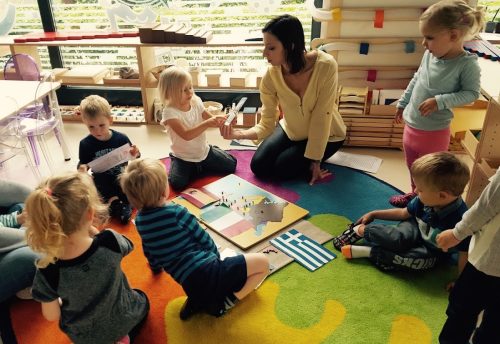
A prepared environment, the child's independence and the teacher's role as an engaged observer and guide are the pillars of the Montessori method, which at Montessori ItsyBitsy preschool are crucial to the adaptation process. Our preschool is designed to inspire children to explore independently and learn by doing. Every element of the environment is tailored to children's needs and abilities, allowing them to feel comfortable and safe. Teachers act as guides who observe and support the children while encouraging independence and their own discoveries.
The key elements of adaptation according to us are:
- prepared environment, which encourages the child to explore;
- close cooperation with parents, responding flexibly and adapting strategies to the specific child;
- presence parent, grandmother, grandfather or caregiver in the facility during the adaptation period! You are welcome with us, you will not be asked out;
- gradual extension of the child's stay. We start with short familiarization visits in the presence of the caregiver, preferring insufficiency at first rather than excess in the child;
- sincerity and honesty Toward the child. Clear communication: where is mom, can she leave now for a while, when will she return? We don't cheat, we don't cry, we don't lie. The child can always go out and cuddle with dad or grandma, who are waiting nearby;
- no sudden moves In the type of snatching the child from the parent's arms or running away from the child;
- accepting all of the child's emotions, including the difficult ones, empathetic support when he cries;
- sverifying whether the child is ready to accept support from teachers when he or she needs it, whether he or she can cry or grieve in front of them and allows someone other than a parent to comfort him or her;
- Parent's willingness to pick up the child early during the adaptation period, when it becomes too difficult, the child is overstimulated;
- and much, much more....
Adaptation of a new child is a delicate, challenging matter and a huge challenge for teachers as well. We do not take shortcuts and do not confuse a child frozen with fear with a calm, „polite”, trouble-free one. However, years of experience tell us that with trusting cooperation between the kindergarten and home, we will go through the process with tenderness, calmness and satisfaction of success.
Strategies for preschool adaptation in the Montessori approach
At ItsyBitsy Montessori Preschool, we use a number of proven strategies to help a child gradually acclimate to a new environment. However, we always put the needs of a particular child and a particular family first.
The most important are:
- TIME! The maxim „Give me time” always accompanies us. Not a rush, not a quick goodbye to „not prolong”. Grass doesn't grow faster when you pull behind it, and certain processes require time, thought and diligence;
- presence of a parent or guardian, any close person at the beginning of adaptation is essential. The parent supports the child and teachers, does not interfere;
- being boring. The parent during adaptation is not supposed to entertain the child and replace the kindergarten staff. The parent reads a book, drinks coffee and hugs whenever the child wants, but does not get involved in preschool activities, gives space and opportunity to the teachers;
- conversation and contact with staff kindergartens: talk about your concerns, suggest your strategies, give us feedback, including critical feedback. Communion is the key to success. And tell us what we are doing right, too! This really works wonders and gives teachers wings.
The role of parents in preschool adaptation using the Montessori method
The role of parents is crucial in the adaptation process. First the parents adapt to the new situation, then only the child. And at every stage of our journey together, we encourage parents to actively participate in preschool life: first by supporting the adaptation process, then, for example, by meeting the children in a circle and reading books to them, or participating in birthday celebrations. The home also plays a crucial role in teaching the child to understand and name emotions, and gives the necessary support in difficult moments and moments of crisis. We always ask parents to stay in touch with teachers and provide information that can help us better understand their child's needs. Together, we create an environment that promotes a safe and smooth adaptation. Talk about your expectations, express your needs - it makes our job easier.
Also, listen to what we have to tell you: we are looking at your child from a new perspective, it is worth taking advantage of it. As you know, it takes a whole village to raise a child, and we want to be part of your social support network. In turn, we pledge not to complain, whine, judge or lecture. We know that we can never see the full picture of your life and the challenges you face.
Adaptation in kindergarten - the most common questions of parents
Parents have many questions about the adaptation process, which we try to find answers to together, supporting them in their role as caregivers. We discuss how long adaptation can take, the natural reactions of children to a new environment, and how best to support a preschooler in new experiences. We are always open to questions and concerns. We see each particular child and always act for their best interests. Parents are usually bothered:
- How long will it take? Once he „normally” goes to kindergarten?
This is a very individual matter, depending mainly on the sensitivity of the child and his past experiences and experiences. In our experience, adaptation usually takes from 3 days (some are really fast!) to 2-3 weeks. And it's not worth rushing this process by force, believe us! This is just a moment in the perspective of your child's childhood, give yourself and him time. - Can an adaptation fail? How often do they fail?
Yes, it can. It happens very rarely, but it does happen. The child may not be ready, too sensitive, too immature yet. He or she may need more exclusive time with a parent. It is worth choosing a facility that will tell you honestly about this. It is not worth doing anything by force, it is usually counterproductive. We happened to return to adaptation after a few months break agreed with the family and it worked like magic. - What to read to a child to support kindergarten adaptation?
Books about going to kindergarten are plentiful on the market. Most, unfortunately, promote a behavioral approach to the process, praising the hero-new kindergartener for „being brave,” not showing longing and not causing trouble. In practice, this is tantamount to promoting an attitude of negating the child's own feelings. These are also unrealistic expectations for many children, violating their self-esteem. We recommend the item of the Mamania publishing house „Ignacy goes to kindergarten”, whose protagonist is a boy who is sensitive, cautious and undergoing a gentle adaptation in a Montessori environment. You can buy this book or borrow it from our kindergarten.
Adaptation in kindergarten - the key to success in Montessori
At ItsyBitsy Montessori Preschool, we believe that properly conducted adaptation is the foundation not only for success at the first stage of education, but more broadly: the basis of a child's mental health. We do not condone any violent techniques. If you are looking for a place where your concerns will be heard and your child's needs will be put first, contact us for a familiarization meeting. In developing our program and adaptation strategies, we relied not only on the tenets of Montessori pedagogy, the philosophy of proximity parenting or the language of NVC, but also on proven methods used in Swiss institutions from which we had the opportunity to learn. Switzerland was the first country outside of Italy to implement Maria Montessori's philosophy in kindergartens on a large scale, and to date its recommendations are largely implemented in mainstream institutions.