

Montessori toys at home. Do such toys exist?
Parenting is a constant search for the best methods to support a child's development. Young parents are hungry for knowledge, searching, and sometimes a little lost, and thus susceptible to various marketing tricks. The category „Montessori toys” is, unfortunately, one of them ... For if anything can be said with certainty about „Montessori toys”, it is that they simply do not exist.
Montessori toys at home
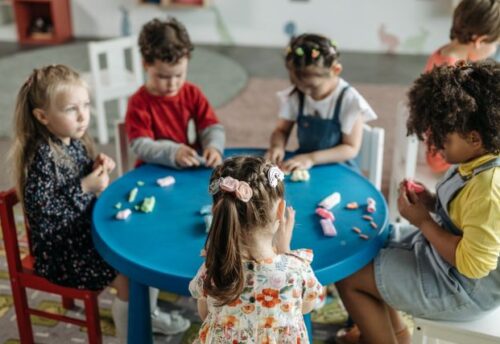
The materials with which Montessori facilities are filled are not toys. Montessori preschools are some of the few spaces designed for children where toys simply ... don't exist! Maria Montessori called a child's activity work. She did so out of respect for his effort and in recognition of his drive to improve himself. What we popularly refer to as ‚play’ is called work in Montessori pedagogy, although it is not at all accompanied by drudgery, boredom, compulsion or monetary compensation. Words have power. Sometimes language depreciates play, saying „she's just playing, she doesn't want to learn!”. Therefore, calling a child's activity „work” can have the effect of appreciating what the child is doing of his own free will, passion, inner drive. Children play, and play is their work; the most important work they have to do.
If not toys, then what fills Montessori preschools?
Montessori's educational and developmental philosophy is based on the premise that children learn best in an environment that is well suited to their needs and allows for free exploration. Our shelves are filled with developmental materials. Sometimes we just call them Montessori materials or aids.
Montessori aids vs. toys
Aren't they by any chance toys, only that a bit old-fashioned, made of wood, glass or porcelain? Absolutely not! Montessori aids, overwhelmingly designed and tested over the years by Dr. Montessori herself, meet several key criteria.
Key features of Montessori aids
First, they serve a specific purpose (e.g., they introduce through a concrete, physical object, an abstract mathematical concept). Second, they are characterized by the so-called isolation of difficulties, that is, if they introduce a concept, then only one at a time. If the aid is used to improve color knowledge, it no longer deals with shapes. And if the material is designed to give the child an idea of size, it will not have differentiated color or texture. Third, they have error control written into them. The child himself is able to tell if he has done the material correctly, and does not need the teacher or his red pen to do so. Fourth, they are introduced through special presentations in the right order by a person who thoroughly understands the meaning and principle of their operation and knows well the child who is to work with them. A prepared teacher is able to guide the child through the steps of initiation, sees the child's readiness or lack thereof and reacts accordingly. He observes, adjusts, supports, but does not bail.
Respect and aesthetics in the use of materials
Montessori materials are treated with respect in a Montessori space, we protect them from damage and use them as intended. There are many more principles for the creation and use of Montessori aids, all of which flow from Maria Montessori's deep knowledge of the learning process gained through decades of intensive work.
The importance of aesthetics and workmanship
Aesthetics and quality of construction of the aids are also of great importance. Children are sensitive to beauty, harmony and order, and Montessori materials respond to these needs, too. Dr. Montessori took care of every detail in her iconic aids, testing different colors, materials, shapes, checking how children reacted to them. She removed those aids that did not arouse interest, modified those that were not very successful. Montessori aids are also constantly created by teachers, always respecting the principles of their creation. Seasonality and thematicity of aids reign supreme in our school. In a Montessori kindergarten that cares about the variety of aids and their rotation on the shelves, it is really hard to get bored and very difficult not to develop.
Is it worth doing Montessori preschool from home?
First of all, it is very difficult. It requires one caregiver to acquire really extensive and deep knowledge. Second, complete equipment for a Montessorian room is extremely expensive. Third, we rarely have enough children at home to make a group of them that can work together, form various relationships and regroup as needed. So optimally, at least twenty children aged 3 -6 ;). Fourth and most importantly, why?
Montessori preschool will provide your child with enough academic, emotional and social stimulation. And after kindergarten, let there be time to work without using standard aids! Playing in the mud, in the sand, swinging, walking, looking at books or playing with a wooden spoon on pots are developmentally invaluable. And some salutary boredom! Let the house be a home and parents have time to roll around on the carpet together. You really don't have to have a complete gold cloth or Sequin board at home, cups for pouring water, a ball and books are enough.
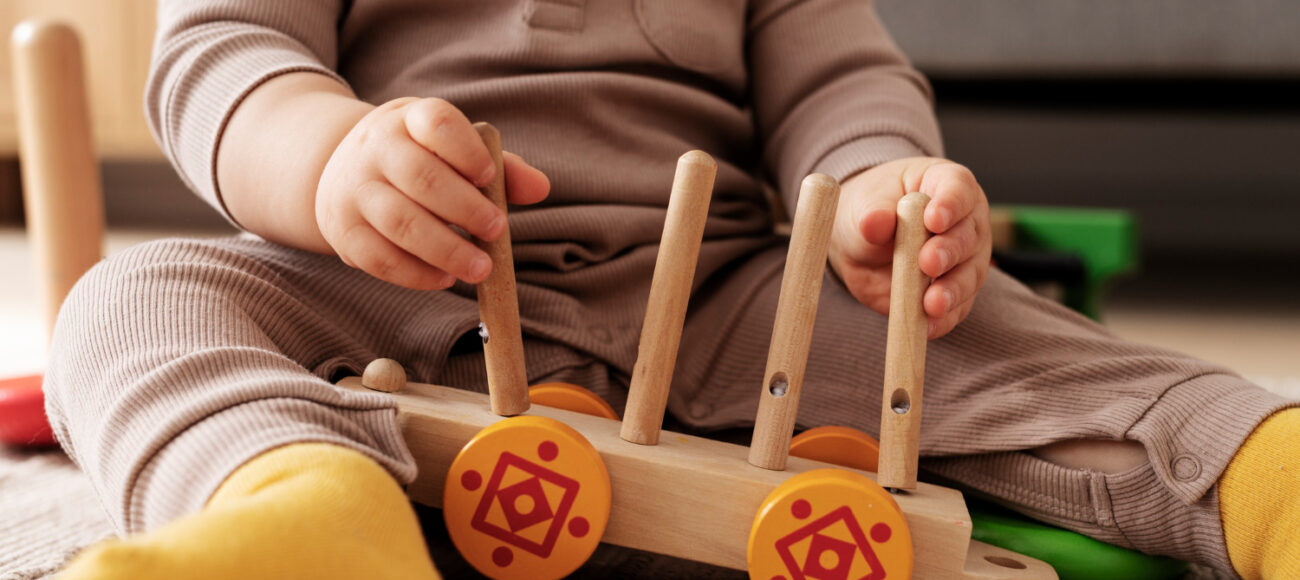
If something is made of wood and designed for children, is it a „Montessori toy”? Beware of offers from stores that sell wooden toys under the banner of „Montessori toys.” Such toys can be beautiful, valuable, give a lot of joy and are worth buying some! But they have nothing to do with Montessori pedagogy. They are toys precisely, not Montessori aids. If an object is beautiful, simple, of good design, made of noble materials, it may refer to Montessori aesthetics, but it is still a toy. Therefore, it is worth having expectations for it appropriate for a toy. Such an object can give a child a lot, but it will not educate him in the Montessori system :).
How to choose toys for a child?
Maria Montessori pioneered so many trends and anticipated so many later discoveries that it can be overwhelming to a mere mortal. When it came to furnishing a child's room, she was definitely on the side of minimalism. However, she did not fall into extremes and empty spaces were not her ideal. She noticed during her stay at a home for children then known as developmentally delayed (and they were de facto extremely neglected...) that for lack of anything to manipulate, they played with bread crumbs that fell on the floor during a meal. She realized that people like oxygen need stimuli, something to occupy their hands and intellect with. A Montessori-style space for a child is a space that is not overloaded, but filled with interesting, age-appropriate objects. They should be within reach of the child's hands, so that he doesn't have to ask someone over 110 cm tall for them.
Likewise, clothes, snacks and water should be available within reach. In a Montessori-style room, a young child sleeps on a mattress on the floor rather than on a bed, because it is easy for him to get off and he is not in danger of falling.
What should be taken into account when choosing toys for a child's room?
- Number: In a Montessori-style room, toys are there, but they do not overwhelm the space or take up most of the floor. It is worth having more, for example, realistic animal figurines, which provide many opportunities for so-called semantically rich play, such as role-playing.
- Age of the child: Toys should be adapted to the child's stage of development. For infants, choose simple sensory toys, such as rattles or soft cubes. It's a good idea to have a few items in contrasting colors (black, white, red), as long as the sense of sight is at an early stage of development, Older children can benefit from more advanced construction sets, blocks or puzzles.
- Safety: Make sure the toys are made of safe, non-toxic materials and do not have small parts that could pose a choking hazard for younger children.
- Workmanship: Good quality toys are usually made of wood and other natural materials. There are also, of course, plastic toys that defend themselves by quality or function. Or they simply fulfill some child's dream.
- Functionality and fostering creativity: At home, it's worth having open-ended or ‚open-ended’ toys, which can be used in many creative ways. Art materials (papers, glue, tissue paper, plasticine, plastic masses, fabric scraps, paints and crayons) are creativity stimulators for children, and it is worthwhile to ensure a constant supply of them.
Good toys for children of all ages
0-2 years
At this age, children intensively develop their senses and motor skills. Recommended toys include:
- Rattles and soft cubes: Promote sensory development.
- Shape sorters: They help develop hand-eye coordination.
- Sensory boards (simple, without excess elements): They encourage the exploration of different textures and shapes.
3-5 years
Children at this age begin to develop more advanced manual and cognitive skills. Here are some recommendations:
- Puzzles and jigsaw puzzles: Promote logical thinking and problem-solving abilities.
- Construction Kits: They help develop spatial imagination and technical skills.
- Threading toys: Promote the development of precise hand movements.
6+ years
Older children may benefit from more complex toys that promote intellectual development and creativity. These will include, for example:
- Science experiments: Chemical or physical experiment kits develop scientific interests.
- Musical instruments: They encourage the development of musical and listening skills.
- Educational books and puzzle games: Promote intellectual development and analytical skills.
Organization of space and time for play
- Space: Create a play area in the house that is properly lit and free of unnecessary distractions and decorations. Toys should be easily accessible to the child, preferably placed on low shelves. Jumbled, neglected, unsorted toys hidden in a big box are unlikely to encourage play.
- Toy rotation: To keep your child's interest, it's a good idea to change the available toys regularly. This can be done every few weeks, introducing new items and hiding those that the child is bored with.
- Routine: Introduce fixed play times that are part of the daily routine. Be all for your child then, don't answer the phone or scroll discreetly on Instagram . No toy will ever be more attractive to a child than your participation in play!
Montessori toys - summary
Toys are excellent tools for supporting a child's development in the home environment. Thanks to them, children learn independence, develop motor skills or the ability to concentrate. And they relax! By choosing the right toys and organizing a space for children to play, we can create the optimal conditions for their learning and development at home. And let's leave Montessori aids where they belong - in Montessori institutions.
If you are a parent who would like to see if a Montessori preschool is right for you, we encourage you to contact us. We'd be happy to tell you more about how we operate and why.