

Montessori Kindergarten
Choosing a form of education for our children is a dilemma for many parents. Is a Montessori kindergarten a better option than a conventional facility? What about one-year kindergarten preparation, known as kindergarten, in the Montessori system? Will Montessori kindergarten prepare my child well for school? Won't a conventional school after Montessori kindergarten be too much of a shock? These questions bother many of us, so it's worth taking a closer look. See what a Montessori kindergarten looks like.
Montessori method and individualization of the learning process
The Montessori method, known and respected for more than a century, places special emphasis on the development of the child as an individual. Central to the program is the child's individual pace and rhythm of development, his sensitive phases (e.g., writing and reading) and the adaptation of the environment to the child's needs and interests. In Montessori institutions, both kindergartens and schools, the child is not merely a recipient of content, but an active participant in the educational process. The difference between the Montessori system and convention is vast and fundamental. Freedom, independence and self-discipline are among the key values of the Montessori philosophy. And these are not empty words.
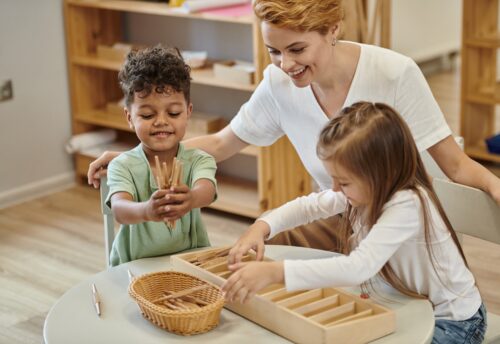
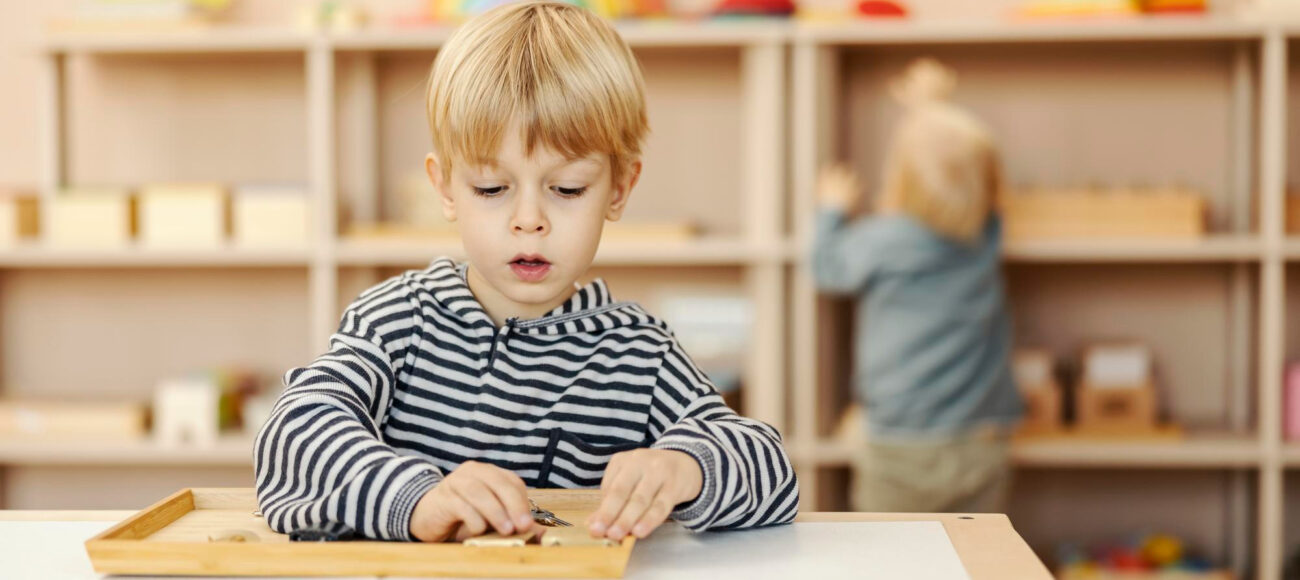
In a Montessori kindergarten, a child enjoys completely different privileges than in conventional education. He is treated seriously, with respect, but also with understanding of his current level of development, needs and abilities. He will always receive the necessary help, but will not be unnecessarily catered to. He will use glass and porcelain utensils, and their eventual breaking will be a natural learning of consequences. He will independently plan his work, do it and finish it for his own satisfaction. No manipulation, grading or bribery will be used against it. It will be able to develop its natural intrinsic motivation, which, as numerous studies prove, is effectively stifled by punishment, rewards, comparison and evaluation.
Annual preschool preparation in the Montessori system
The practice of Montessori „kindergarten” places special emphasis on the continued development of six-year-olds by creating an appropriate environment (known as a prepared environment) that addresses their current needs, as well as the harmony and comprehensiveness of this development. The pillars of the Montessori method remain unchanged, including uninterrupted self-directed work time that promotes focus and deepening of interests.
Among other things, we value Montessori in kindergarten:
- focus on the real world (natural and cultural). We free up resources often devoted to Psi Patrol (no offense :)) and redirect them to the life cycles of insects and amphibians, galaxies and black holes, the structure of the Earth or understanding other people's emotions;
- learning to work with others in joint ventures and projects;
- Learning responsibility for themselves, others and their environment. The children are the hosts, taking care of their room and group;
- A chance to be a mentor to the younger children in the group! This is a very important social experience. Six-year-olds are eager to help new children adapt, introduce them to the world of Montessori materials and group rituals. After being the youngest, then the middle, they are finally the oldest, the best versed, and by sharing their knowledge, they are already expanding and consolidating! Believe us - no one can introduce a toddler to the world of kindergarten like an elder in the group. Both sides are winners in this arrangement!
- learning how to independently plan work, carry it out and finish it. This is truly invaluable and you will appreciate these competencies in the first years of school! Lack of independence and confusion are the main problems identified by early childhood education teachers in schools. Montessori preschool gives a really good grasp of life. From knowing how to get dressed, to preparing a snack (and cleaning up afterwards!) to checking facts about a microraptor in a prehistory album.
- new brings six-year-olds! Along with the new responsibility (we're getting ready for school, this is where we work!) come new privileges. Special goal sheets for the week, individual teacher-prepared assignments (just for me!), our own folders, more advanced presentations of Montessori aids... And you know - tea meetings to sum up the week!
Montessori kindergarten and engagement in the educational process
One of the key elements of Montessori preschool is the involvement of children in the learning process. In this method, the teacher is not a supervisor or judge, but an attentive, engaged observer and guide who supports the child in exploring the world. The role of such a teacher is more demanding than in conventional education, but it also gives plenty of satisfaction. The child is truly treated as a subject here. Children in Montessori have a voice (just like fish, which also make sounds, so the saying from our childhood is doubly inaccurate:)).
Advantages of education in the Montessori system
Children raised in Montessori institutions gain a range of social and independence skills that are extremely valuable throughout our lives. This form of education places special emphasis on a child's emotional and intellectual development, which translates into a child's healthy self-esteem and ability to cope with challenges. Six-year-olds in Montessori institutions have the opportunity to work in small groups, which promotes focus and a deeper understanding of the issues being worked on. In addition, each week ends with a summary of the work with an opportunity to share experiences with classmates. These our unique tea meetings, full of warmth, laughter and exchange of emotions, are a favorite ritual of the six-year-olds.
Scope of learning and skill development
In Montessori kindergartens, children have the opportunity to develop competencies in various areas, such as language, mathematics and broad world knowledge. The program includes geography, as well as elements of botany, zoology, geology or astronomy. Rich developmental material and individual or small group work promote a deeper understanding of issues and the development of independence and creativity. The core curriculum provided for one-year preschool preparation in Poland covers a much smaller range of competencies, skills and knowledge than what children experience in good Montessori institutions. Without coercion, without pressure, organically as it were, though under the wise guidance of adults, children have a chance to master writing, reading and quite a bit of arithmetic, including often multiplication and division. They are not afraid of large numbers and operations on them, and have quite a bit of knowledge about the natural and cultural world.
Montessori Kindergarten is a space where a child can develop autonomously, gain knowledge through experience and develop social skills in a safe atmosphere. With an individualized approach and rich developmental material, each child has the opportunity to develop his or her unique potential and prepare for further learning with a healthy sense of self-esteem and openness to the world.
Montessori Kindergarten at ItsyBitsy
We have been nurturing the development of our children for 9 years, and quite a few ‚graduates’ have already left our walls. We are in contact with many of them, including those who now live outside Poland. We listen carefully to them and their parents, who share their first school experiences with us. Most of them are very positive. Our kids boldly set off to conquer schools, further develop their passions and interests, and are curious about the world . Sometimes they can be a challenge for teachers, because their academic competence is sotsunkenly high.
Many parents appreciate that, thanks to early independence and serious treatment, they do well in bringing tasks to completion, and rarely forget the legendary blotter and ‚gifts of autumn’ FOR TOMORROW. And most of all, they have conscious involved parents who are as demanding towards the new school as they were towards kindergarten. They always stand by the children's side and respond when support is needed. We dare say that families with Montessorian experience in early childhood education are an important factor in the quality of our schools, including conventional ones!