


How to support a child's interests using the Montessori approach?
The Montessori approach places special emphasis on the individual development of the child and his or her natural curiosity about the world, even an organic, innate drive to grow. In Montessori institutions, each child is treated as a unique individual whose needs and interests form the basis of the educational process. So how do you support a child's interests using the Montessori approach?
Why support your child's interests?
Fostering children's interests is key to building healthy self-esteem, self-discipline and developing cognitive and emotional competence. When a child has the time and space to pursue his passions, he gains motivation to learn and is eager to engage in a variety of activities. This approach allows him to discover and develop talents and understand his own strengths, which is invaluable at every stage of life. Living with passion is simply a fulfilled, meaningful life! And this is true regardless of whether one is five, fifteen or forty-five years old. There are no better or worse passions!
In addition to classics such as dinosaurs, trains and planets, children's minds can be consumed by a variety of interests. Maps, hieroglyphics, reptiles, mythology, dancing, running and skipping are the less obvious, but by no means inferior childish passions. We strongly recommend keeping an open mind and accepting with curiosity what is currently alive in our children.
The principle of freedom in Montessori - how to support children's passions
In the Montessori approach, the principle of freedom of choice is central. Children have the opportunity to decide for themselves what they want to do, which promotes the development of their interests in an unrestricted and authentic way. This allows the child to explore the world around them on their own terms, while developing at their own pace. This freedom does not mean the absence of boundaries - the teacher or parent acts as a guide who supports and organizes the child's environment, but also takes care of himself.
Everyone has their own boundaries (they don't have to „put them up” in any particular way), and the Montessori approach recommends caring for one's own boundaries as the best way to develop a healthy self-defense mechanism in a child. Thus, if a child's passion becomes, for example, playing loudly on percussion instruments, which obviously disturbs other household members, it is worth considering reconciling one's own boundaries with the child's „screw up.” There will be quite a few strategies, such as playing at an activity outside the home or electronic drums that no one but the player can hear.
The role of the teacher as an observer and guide
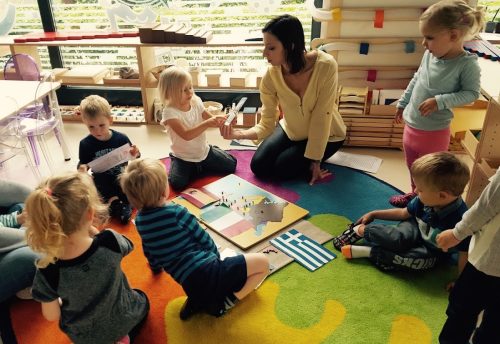
In Montessori pedagogy, the teacher, or in the home context, the parent, is an attentive observer who helps the child discover his or her interests. It is through observation that one can see what engages the child the most. Based on this, we adjust the educational environment, offering the child appropriate materials, activities and challenges. The teacher does not impose topics, but gently guides the child toward activities that spark his curiosity and passion.
Prepare an environment that supports interests
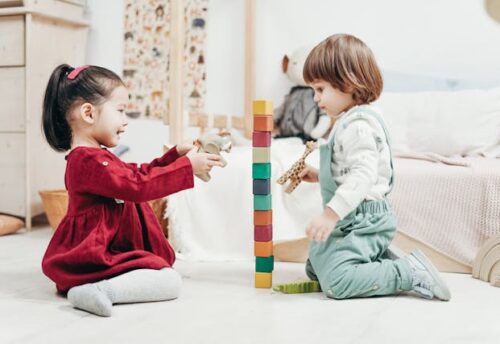
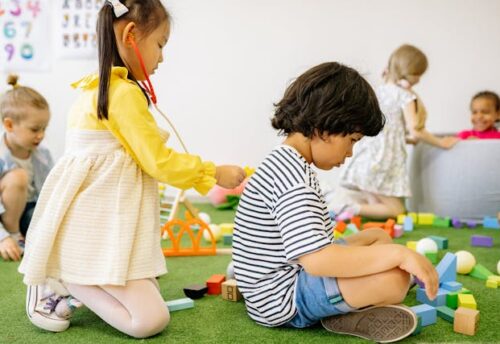
A key aspect of fostering children's passions is preparing the right environment. In a Montessori preschool, children have access to carefully selected developmental materials that are varied and thus respond to many children's interests. The environment should be orderly and provide choice, which promotes independence. Such an environment encourages exploration and development in accordance with one's own interests. Here are some ideas on how you can set up a space for your child to develop passions at home:
Passion for dinosaurs
Organize a paleontology corner with dinosaur figurines, books about dinosaurs and an excavation play set (e.g., a sandbox with buried bones to explore). Create a board with a timeline of the prehistoric world, where the child can place dinosaurs and learn about different geological periods.
Fascination with space
Prepare a place with books about the planets, models of the solar system and simple sets for experiments with flashlights that can depict the movement of the Earth and Moon. On the ceiling or walls, hang glow-in-the-dark constellations and planets that the child can recognize and name.
A love of animals and nature
Create a nature corner with a terrarium (a stick insect, spook or African snail can live in it), potted plants and books about plants and animals. You can also put up a magnifying glass for viewing the details of plants and insects. Set up a bird-watching area with binoculars and a feeder outside the window so your child can learn to identify different species.
Love of vehicles and construction
Prepare a space with a large city map or a carpet with streets, where the child can drive cars, build bridges and parking lots with blocks. Organize a construction corner with different types of blocks (wooden, magnetic), which can be used to create structures referring to machines and buildings.
Passion for cooking and food
In the kitchen, create a cooking corner with safe tools for the child: bowls, measuring cups, silicone cake molds and a book with simple recipes. Organize a mini herb garden on the windowsill, where the child can grow his plants and then use them in the dishes you prepare. Don't have the desire, space and time for all this? We understand! Perhaps the best strategy for you is to simply enroll your child in a Montessori preschool, where his passions will be taken care of. And someone else will clean up after that plant transplanting or digging in the sand!
Examples of activities to support diverse interests
Children are different, so it makes sense to tailor activities and materials to their passions. For art lovers, it can be paints and canvases, for science fascinators - materials for research and experimentation. Children interested in math can use Montessori aids, which - like nothing else - develop logical thinking and analytical skills. A passion for music can be fostered through instruments and rhythmic activities.
Support the child's interests naturally and without pressure
One of the most important elements of fostering children's passions is avoiding pressure. Children develop best when they feel free and are not forced to achieve certain results. Parents can create space for exploration, but it is better not to impose direction on the child or expect specific or quick results. It is important that the child feels accepted and can develop at his own pace.
Benefits of fostering a child's interests in the Montessori spirit
The Montessori approach allows the child to develop comprehensively. Children who can pursue their passions become independent, creative and open to new challenges. They gain critical thinking and problem-solving skills, which prepares them to deal with life's challenges now and in the future.
What if your child has no passion?
In the Montessori approach, a child's lack of a specific passion is not a cause for concern, but an opportunity for collaborative discovery and exploration. In such a case, careful observation and the creation of an environment rich in a variety of opportunities that can inspire the child to explore his interests play a key role. Perhaps he is a young man of renaissance and will pay attention bit by bit to different topics and areas of knowledge.
Opening up new opportunities for the child
It is the privilege and responsibility of the parent to offer the child a variety of activities and educational materials that can help him discover what really fascinates him. You can start by providing a wide range of options, such as books on different topics (nature, technology, art, history), experiment kits, art supplies or construction toys. It's also a good idea to involve your child in different experiences, such as walks in the woods, trips to a museum or cooking together.
Observation and patience
A parent, like a Montessori teacher, can carefully observe what attracts a child's attention, but not put pressure on it. Sometimes a child needs more time to become interested in something, and it is natural that interests may develop slowly. It is important to be patient and give the child space to experiment freely and try different things.
Encouragement without imposition
Encourage your child to engage in new activities, present options, but at the same time do not impose topics, activities or your ambitions and expectations. It's not bad to try ballet and abandon it after a few lessons. Occasionally ask your child if he or she would like to try something new, but don't demand that he or she necessarily get into it. A calm and supportive approach with no pressure to achieve specific results usually works best!
How to support your child's interests - summary
The Montessori approach gives children the opportunity to explore and develop interests in a natural and joyful way. By fostering children's passions, we foster an environment that encourages creativity, independence and curiosity about the world. Discover what really fascinates your child and support them in developing these passions, giving them the space to realize them to the fullest.