

Mathematics by the Montessori method - what's so special about it?
Exploring the world of mathematics using the Montessori method is a unique experience for the preschool child, fundamentally different from the conventional approach used in mainstream institutions. Although early mathematics teaching in kindergartens and so-called "traditional" schools has been inspired by the Montessori method for many years and tries to draw on this trend, the full program of children's mathematical and logical development in a Montessori institution is still unique. In turn, it works effectively and in accordance with Maria Montessori when implemented consistently and holistically throughout the early childhood period (3-6 years). The Montessori method, as a child-centered approach, emphasizes learning through action, multi-sensory experience and discovery.
Montessori method and discovering the world of size, length and number relationships
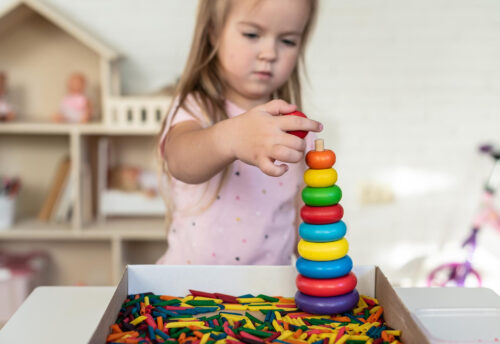
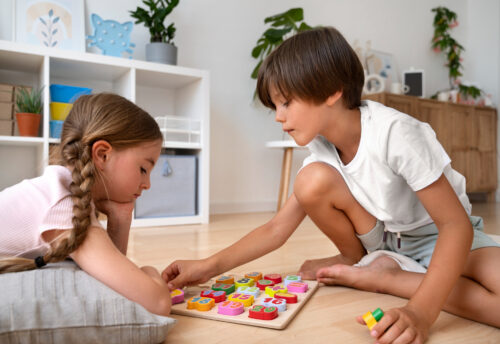
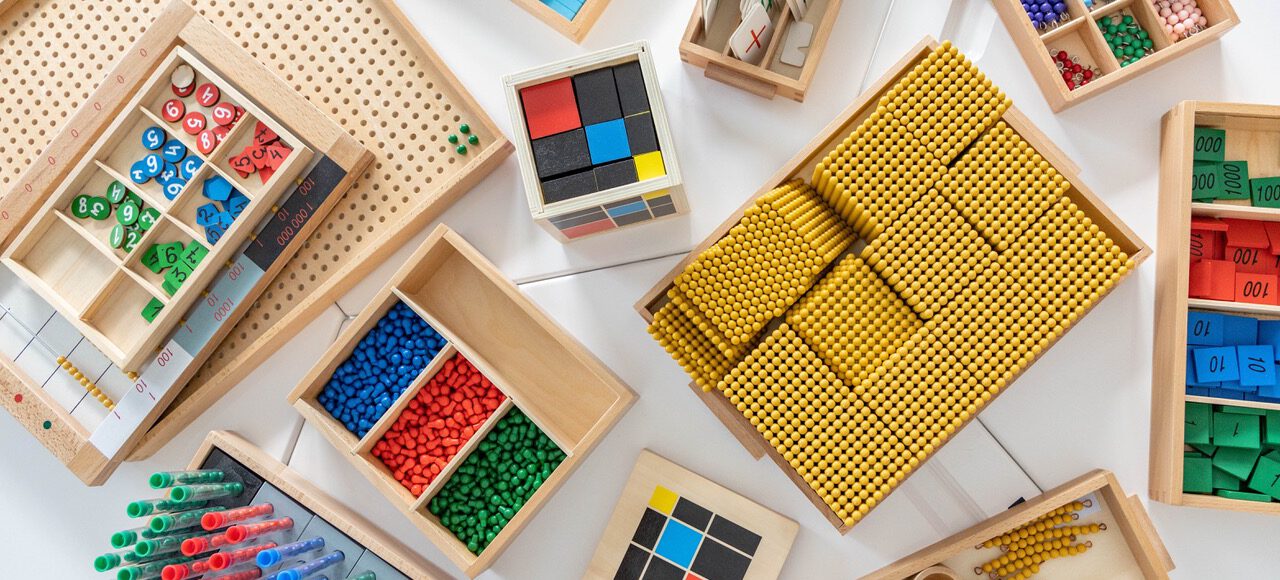
The Montessori way of teaching math differs from conventional methods. Montessori teachers know that children assimilate mathematical concepts when they are presented in concrete and practical ways, rather than abstractly. Instead of abstract instructions, children use objects to manipulate, such as a variety of beads, blocks and cubes, to understand mathematical concepts on a sensory level, to store them in not only visual but also muscle memory.
Not all at once, or phases of learning math
In the Montessori method, math learning takes place in three stages: sensory, concrete and abstract. The sensory stage is aimed at developing the senses and understanding mathematical concepts through exploration, touch, maniupulation and experimentation. It is through comparing red beams from 10 to 100 centimeters long that children sensually discover the world of size and the relationship between them. What is bigger, what is smaller? How much is 50 cm smaller than 100 cm? What part of 100 cm is 10 cm? All this is fixed in the child's deep, muscular memory. All the senses are involved. And these are not trivial or trivial matters, they are a solid foundation for really advanced abstractions and mathematical concepts. The beginnings of mathematical thinking have nothing to do with reciting the names of numbers learned like a rhyme („count to 10!”). Work on mathematical and logical concepts begins by manipulating objects in space, carrying them around, arranging them in various configurations, discovering patterns and relationships between them. Isn't this the same thing that happens during any play with blocks? Almost, but not quite. Montessori sensory aids are carefully designed and meet strict criteria. And a prepared adult can present them to a child in the right way and in the right order.
During the concrete stage, children use manipulatives to learn basic math concepts, such as counting, addition, subtraction, multiplication and division. Finally, at the abstract stage, children use symbols and numbers to represent mathematical concepts. At the same time, it's worth noting that these numbers and symbols were also introduced earlier through sensory methods, including rough numbers or tokens.
What to expect from learning math using the Montessori method?
Initially, children learn the concepts of size, weight, length, comparing these values, then gradually counting, and finally recognizing number symbols and connecting them to sets of objects. Learning to count is done gradually, with the decimal system (ones, tens, hundreds, thousands) being introduced from the beginning. The whole process requires the use of different types of objects for manipulation, such as beads, chains or blocks, to represent numbers and work with them in space. Children also learn number recognition through hands-on activities, such as matching cards or using charts with shorthand numbers, so that the shape of Arabic numbers comes to them not only through the sense of sight, but also through touch. This is an important step in learning to write - both letters and numbers.
Once children master counting and number recognition, they move on to learning basic mathematical operations such as addition and subtraction. In the Montessori method, children again use manipulatives to understand these concepts. For example, they can use beads to add and subtract, or use a number line to understand relationships between numbers.
As children progress, they learn more advanced math concepts, such as multiplication and division. These activities are taught through hands-on activities using manipulatives. Children will use beads and cubes to learn the multiplication table, as well as use special multiplication and division tables. No memory mastery of the multiplication table is expected at this stage; the goal is a deep understanding of the relationship between numbers. With the right dose of practice, which in Montessori is possible without boring the child, because we have a large number of various mathematical aids, it is possible that forging multiplication tables by heart will never be necessary. Nevertheless, the child will remember the results of most multiplication operations in the range up to 100.
Give me time!
One of the unique aspects of Montessori math teaching is that children are encouraged to work at their own pace. Here, there is no comparing, grading, rushing or imposing a pace by an adult. Montessori teachers understand that each child has his or her own learning style and individual aptitude. Therefore, they provide personalized education and allow children to move through the curriculum at their own pace.
Another important aspect of teaching math in Montessori is the integration with other areas of the curriculum. Children learn about fractions while cooking or learn about measurement concepts during art projects.
A world of big numbers
The Montessori preschool program is not limited to counting in the range of 10 or even 100. Children learn the entire decimal system and perform operations on large numbers. Some of the materials allow them to work with thousands, tens and hundreds of thousands. And very many children turn out to be fascinated by the world of large numbers, although the beginnings of their adventure with arithmetic did not indicate such a passion.
Not only arithmetic, or geometry for the preschooler
Montessori materials also cover a lot of flat and spatial geometry. Children work on sets of triangles, learning in practice the properties of this fascinating figure, and have solids available, among other things. The introductory material of solids allows children to get acquainted with the concepts of sphere, cube, pyramid, owoid, ellipsoid or cone. The child gets to know them visually and tactilely, learns to distinguish and name them.
Summary
The Montessori method of teaching mathematics is a proven way of imparting mathematical knowledge and skills to preschool children for more than 100 years. Through the use of manipulatives and active learning, children develop a deep understanding of mathematical concepts and build a solid foundation for further mathematical education. Montessori mathematics teaching is based on each child's individual pace, relies on concretes and integrates with other areas of learning. At ItsyBitsy Montessori Preschool we implement the full Montessori curriculum, including math. We have a rich database of math materials and are constantly working to expand it. Our teachers are fully qualified in the field of Montessori pedagogy and continue to expand their competence at trainings, in-depth courses and international conferences. If you would like to get to know us better and see for yourself how children can develop and reach their full potential in a friendly and stimulating educational environment, schedule an introductory meeting with us. Feel free to contact us, we will be happy to introduce you to the world of Montessori pedagogy and modern preschool education.