

How does Montessori support a child's social development?
From the very beginning, a child learns the world through relationships - with adults, peers, the environment. Social development is not an add-on to education, but its foundation. The ability to communicate, cooperate, face conflicts and be part of a community are competencies that are crucial to human well-being - both in childhood and adulthood. In Montessori pedagogy, a child's social development is not something that „happens on a break” - is an integral part of daily life in the preschool. It is an environment that, by design, fosters self-reliance, attentiveness to others and responsibility for oneself and the community. Children are not taught to „be nice” - they experience respectful relationships in which their voice matters.
What is a child's social development?
Social development is the process by which a child learns how to function in relationships. It is not only the ability to cooperate or share a toy, but also:
- reading their own emotions, and then those of others as well,
- expressing one's own needs, over time in a way that does not violate the boundaries of others as much as possible,
- measuring up to conflicts,
- Taking responsibility for oneself and the common environment,
- Building a sense of belonging and influence.
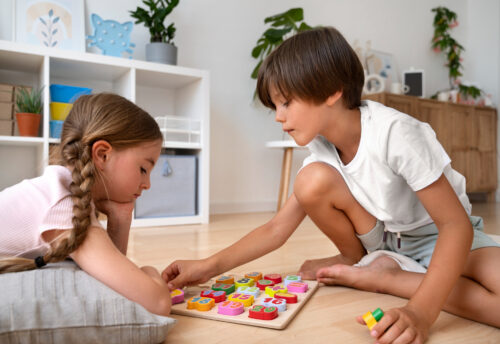
In young children, social relationships develop gradually - from parallel play and imitation of peers, through brief interactions, to the formation of deeper bonds. The presence of adults is extremely important here - not as „supervisors,” but as guides who model relationships based on respect and empathy.
In a preschool group, a child experiences community outside the family for the first time. It is there that he learns that other people are different - and that diversity is not a threat, but a value.
Montessori philosophy and human relations
At the center of the Montessori approach is respect - for the child, for his emotions, decisions and rhythm. It's not just about kind words, but a real recognition of the child as a person who has the right to his or her own choices and experiences.
Children learn to function in relationships through daily experience:
- That their „no” is heard and respected,
- That they can ask for help and will receive it,
- That their emotions are accepted, even if difficult.
It is in such an environment that a child learns authenticity and responsibility - not because someone „explained” it to him, but because he experienced it. Freedom within the boundaries of the freedom of others, self-reliance, the ability to make decisions and co-determination - all this teaches that my actions matter, and that other people also have their own needs and boundaries.
How does the Montessori environment support a child's social development?
One of the most distinctive elements of a Montessori preschool is the mixed-age group. This is not a coincidence - it is a deliberate choice that creates a natural environment for community building.
Children learn from each other: the younger ones watch the older ones, the older ones help the younger ones. A space is created where empathy, patience and attentiveness are not „topics of chatter” but daily practice.
The prepared environment also plays an important role - an orderly space in which everything has its place and function. This makes it easier for children to learn to care for the common good and to see that their actions affect the comfort of themselves and others.
Also important are clear, predictable rules - not imposed from above, but introduced and maintained with care. Rules in the Montessori classroom are not for control, but for a sense of security and shared responsibility.
The role of the teacher as a social guide
In Montessori, the teacher doesn't stand in the middle of the room, tower over the children or hide behind a desk. He doesn't give talks about „kindness” or settle conflicts for the children. He is an observer and guide - attentive, present, ready to support, but not rushing to interfere.
When a conflict arises between children, the teacher gives them time and space to try for themselves. If necessary - he helps: not by judging, but by asking questions, naming emotions, helping them find a common solution.
The adult's own attitude is of great importance here - how he speaks, how he treats others, how he reacts to difficult situations, models children's social behavior.
A child who sees an adult speaking respectfully, apologizing, explaining, asking for help, adopts this way of being and transfers it to relationships with other people.
Summary
In the Montessori approach, a child's social development is not a goal to be achieved-it is a natural part of everyday life that happens in an atmosphere of freedom, responsibility and mutual respect.
Children have the space to experience community - true community based on interaction, diversity and communication. They learn that their voice matters, that relationships need to be cared for, and that differences are not a problem but a resource.
This approach has long-term benefits. Children who have experienced respectful and trusting relationships in childhood enter adulthood with the ability to build relationships, express themselves and be together with others - without fear, without fighting for control, with a willingness to cooperate.
In a world that increasingly needs relational wisdom, this is one of the most valuable competencies we can give children.