

How does Montessori education prepare children for the modern world?
Can the Montessori method, which is over 100 years old, be an effective answer to the needs of modern families? In our opinion, absolutely and without a doubt yes! Because the essence of Montessori pedagogy is not a specific set of content to be crammed into young heads in an administered manner. Content is rapidly becoming obsolete, and access to information is now easier and faster than ever. The heart and meaning of the Montessori method was from the beginning and still is to fuel natural curiosity about the world, nurture intrinsic motivation and feed children's passions. Children should flourish, not try to survive what we give them. Independence, responsibility, cooperation, creativity and flexibility of thought are our core values. In this article, we will look at how Montessori education shapes key competencies that will help children find their way in the dynamic world of the 21st century.
Montessori education vs. individual child approach
The modern world is changing faster than ever. Staggering technological advances, the dawn of artificial intelligence, globalization, and the growing importance of soft skills mean that children need to be prepared for a future we can't even predict. The professions that today's preschoolers will be doing probably don't exist yet, and there are no names for them. Rather, it seems that the adult of the future will change his or her occupation at least several times in a lifetime, and the world will probably require him or her to constantly learn, adapt efficiently to change and revise attitudes or beliefs. Conventional, archaic educational models cannot keep up with the demands of the modern world. Parents are well aware of this gap between the world and education and are looking for meaningful alternatives for their children.
Each child is different, with its own talents, pace of development and interests. And at the same time, our entire species is united by several important characteristics. These are: the need for freedom, self-realization, forming valuable, cordial relationships with others, the need to be noticed, to be relevant, to be of value to others. The traditional education system, based on uniform curricula, often fails to take these individual differences into account, while also ignoring our basic needs. It does not allow us to choose what we want to devote ourselves to right now, how we want to do it, and forces us to follow an imposed leader and pattern of action.
Montessori takes an individual approach to each child, allowing him or her to develop according to his or her natural rhythm and supporting that development. Children have the opportunity to choose activities that interest them, making learning a fascinating adventure rather than an unpleasant, hated chore. The lack of rigid curricula strengthens children's self-esteem and self-confidence, which pays off in adulthood. After all, more important than any mathematical skill is the mental health and well-being of our children.
Development of independent thinking and decision-making skills
One of the pillars of Montessori education is experiential learning. Children learn to plan and organize their own work from an early age, which strengthens their decision-making skills. Unlike traditional schools, where a grading system and rigid criteria for success dominate, in Montessori children monitor their own progress. As a result, they learn to be responsible and reflect on their own progress. This model of education promotes the development of analytical thinking and creative problem solving.
Learning through experience and practice
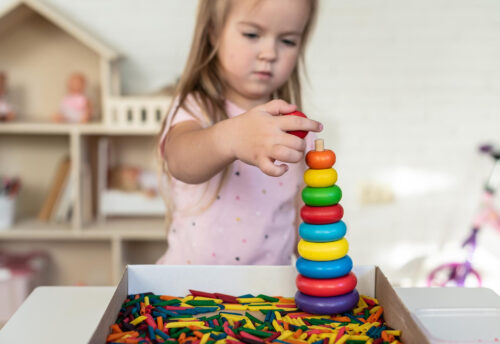
Maria Montessori noted that children learn best by doing, not by listening to lectures delivered by an authority figure. Instead of being forced to passively absorb knowledge, therefore, they should have the opportunity to explore the world by manipulating objects, performing real tasks and sensory experiences, as well as functioning in the world - cleaning, cooking, taking care of themselves and others, going on trips and meeting different people. Let's not limit their world to worksheets and textbooks. Specially designed Montessori developmental materials that meet certain criteria help develop logical thinking, motor coordination and precision, as well as expand their knowledge of the world. This form of learning perfectly prepares children to use the acquired knowledge in practice, which is crucial in the modern world.
Social competence and teamwork
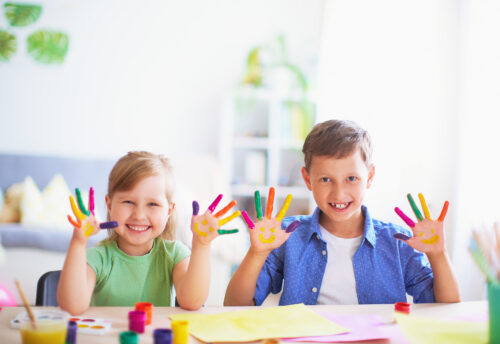
In the Montessori method, children work in mixed-age groups. This reflects natural social relationships and teaches cooperation between differing individuals. Older children help the younger ones, which strengthens their sense of responsibility and empathy. In turn, the younger ones benefit from being with those who can and already know more than they do. Cooperation based on respect, patience and communication makes children acquire social skills. Skills that are essential for adulthood, both in teamwork and everyday interactions.
Montessori education as a path to the future
Children who learn in the Montessori system naturally develop attitudes that will pay off throughout their lives. Independence, creativity and openness to new challenges are skills that will allow them to find their way in a dynamic world. Montessori education not only equips children with knowledge, but also with skills that allow them to develop and adapt to a changing reality. And although they will leave kindergarten with a program of roughly the first three grades of elementary school, that is not at all the most important thing. The most important thing is that they will enjoy learning, acquiring new skills, cooperating with others, and will not depend on external grades, praise or reprimands. This is the capital they will multiply for the benefit of themselves and the world they will come to co-create.
Montessori education - Summary
Montessori is not just a teaching method, not just a pedagogy, but above all a lifestyle and approach to the world. Independence, freedom, creativity, freedom, flexibility of thought and ability to cooperate are competencies that, we already know, are crucial in the 21st century. Montessori teaches children not only how to acquire knowledge (although that too!), but above all how to use it. That's why you should consider this model of education as a conscious choice for your child's future. If you feel like learning more, please contact us and schedule an introductory meeting. We will be happy to answer your questions.