

Sensory development of children - how do we support it in a Montessori preschool?
Sensory development is one of the cornerstones of early childhood - a process that begins from the prenatal period and intensively continues for many years after birth. During the first years of life, children most fully absorb the world with all their senses, and their nervous system matures, learning to perceive, interpret, integrate and respond to stimuli from the environment. Children's sensory development has a special place in Montessori pedagogy - Maria Montessori recognized more than a century ago that adequate support in this area is the basis for further cognitive, emotional and social development. At our preschool, we ensure that children have daily access to a rich sensory environment - designed with their needs and abilities in mind.
What is sensory development for children?
Sensory development is the process by which a child learns to receive and process stimuli coming from the environment through the senses. We are talking not only about well-known senses such as sight, hearing, touch, smell and taste, but also about proprioception (deep sensation, or awareness of one's own body) and the vestibular system (related to balance and motor coordination). Each of these senses develops gradually and requires the right conditions and experiences to form properly.
When sensory development is harmonious, the child easily adapts to the environment, is able to focus on tasks, moves smoothly in space, understands speech and builds social relationships. Disorders in this area can, in turn, affect learning difficulties, anxiety, hyperactivity or withdrawal. That's why it's so important to support children from an early age in developing their senses in a thoughtful, natural way that is appropriate to their stage of development.
The importance of sensory development in the Montessori method
Maria Montessori recognized that the child learns best through direct experience - through action, manipulation of objects, and exploration of the world around him. In her method, she paid special attention to so-called sensitive periods - moments in a child's life when he or she is particularly open to developing a particular skill or area. One such period is precisely the time of intense sensory development.
In Montessori pedagogy, sensory development is treated as the basis for the next stages of education. A child who can accurately distinguish sounds, colors, textures or sizes more easily acquires the ability to read, write or count. By developing the senses, the child organizes his experiences and builds cognitive schemas that enable logical thinking and understanding of the world.
Examples of sensory aids in a Montessori preschool
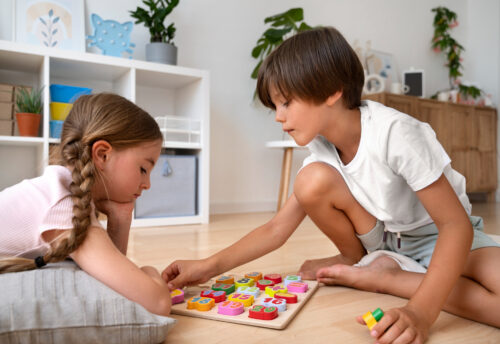
In a Montessori preschool, children use aids designed specifically to develop one sense at a time every day - without unnecessary stimuli, noise or distractions. Each aid has a specific purpose and has been thought out down to the smallest detail:
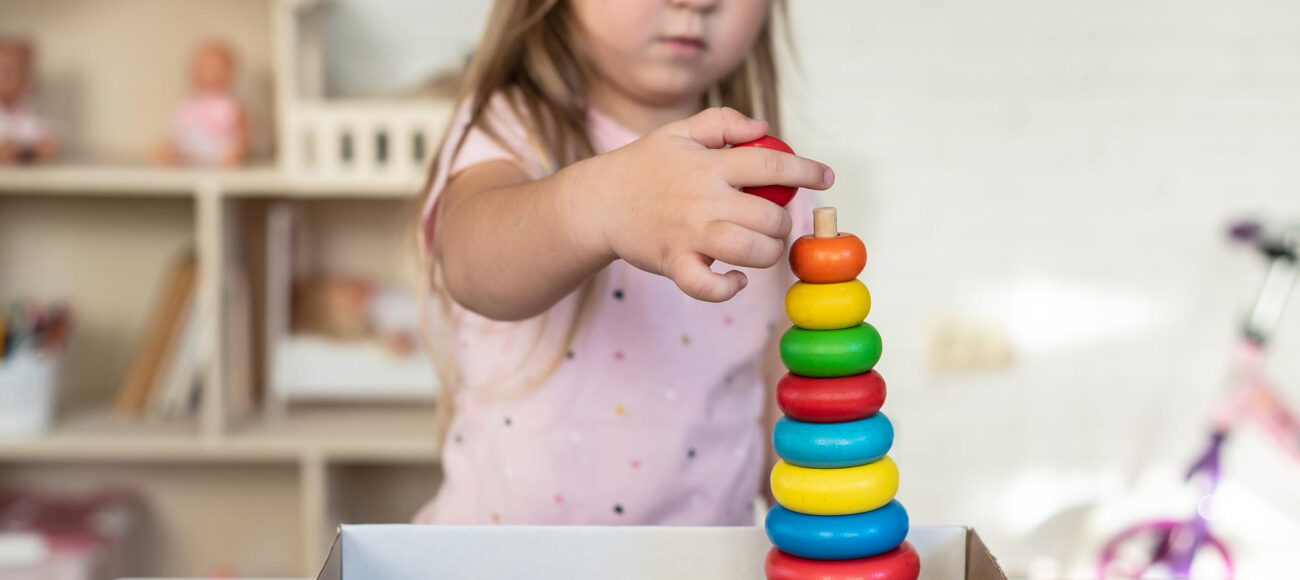
- Pink tower - A set of ten cubes of different sizes that develops vision and spatial perception.
- Brown staircase - A set of variable-thickness cuboids that supports depth perception and size comparison.
- Touchpads - help distinguish different textures and refine the sense of touch. Such work also helps prevent hypersensitivity in this area.
- Cylinders - They teach size differentiation and precise grasping.
- Montessori Bells - identical in appearance, but differing in pitch, develop musical hearing and concentration.
The child works with the materials independently, in concentration, returning to them as many times as he or she needs. There are no grades or pressure - instead, there is space for discovery and improvement.
Daily sensory practice in a Montessori preschool
Sensory development in our preschool is not just about working with materials. It's also everyday experiences that build awareness of the body and the surrounding world. Sifting porridge, pouring water, sorting objects by color, shape or size - these are activities that children perform with joy and commitment. Equally important are housekeeping chores such as sweeping, wiping tables or folding cloths - they introduce rhythm and give the child a sense of agency.
Outdoor movement is also an integral part of the day. Walking, observing changes in nature, gardening or touching wet grass barefoot - all these develop not only the senses, but also attentiveness and sensitivity to the surrounding world.
Children in a Montessori preschool also have the opportunity to choose their own activities, which further supports the development of their intrinsic motivation and allows them to follow what interests them most at any given time. The calm, quiet and orderly environment is conducive to allowing them to take full advantage of their natural predispositions and develop at their own pace. Overstimulation, which is one of the main problems of preschool children, affects Montessori children to a lesser extent.
Sensory development of children - summary
Children's sensory development is much more than learning to recognize colors or sounds. It's building the foundation on which a child will base all of his or her further development - physical, emotional, cognitive and social. At Montessori Preschool, we support this process consciously, thoughtfully and with care. We create an environment that allows children to experience the world with all their senses, while giving them space for independence, concentration and the joy of discovery. We believe that it is the attentive presence of adults and a properly prepared environment that makes it possible for a child to develop fully - harmoniously and naturally.