

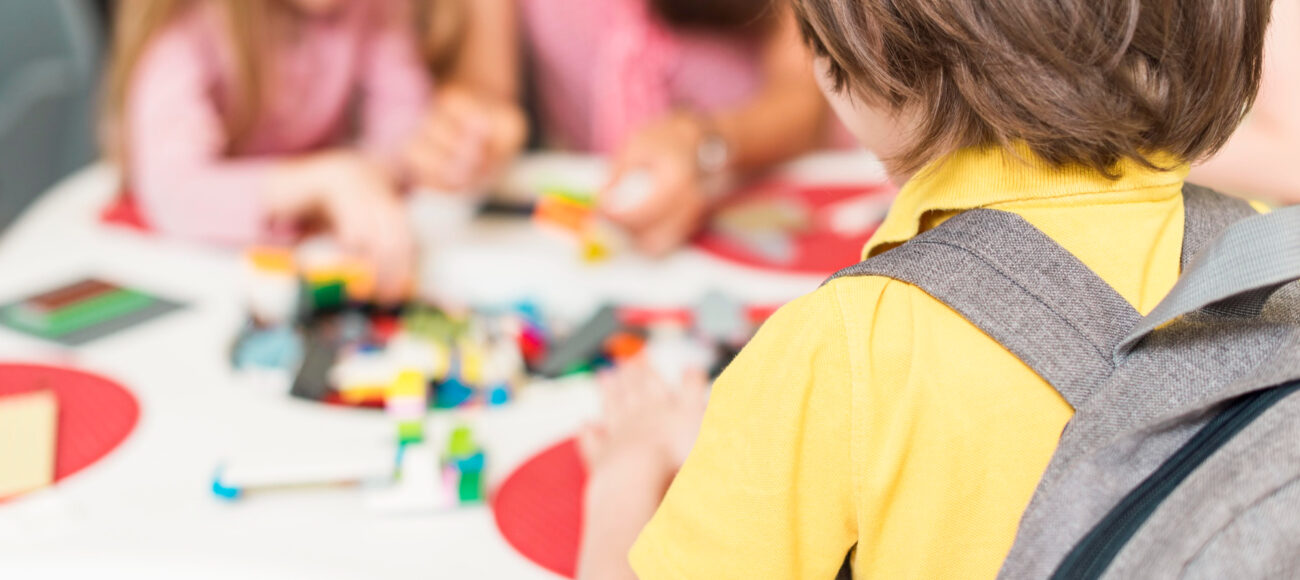
Preparing a child for elementary school after Montessori preschool education
The Montessori method, created by Dr. Maria Montessori and developed by her and her colleagues and successors over the past 100 years, is known worldwide as one of the most effective and supportive ways to educate preschool and school-age children. Its popularity stems from its holistic approach to child development, which encompasses not only academic skills, but also social, emotional competence and physical development. The crux of the Montessori philosophy is to support the child in developing independence, responsibility and the ability to cooperate with others.
Starting education in the Montessori system is of course advisable, if not essential, if you want to send your child to a Montessori school. In this case, good habits and passion for learning, developed in kindergarten, will pay off in school. The child will fully use the knowledge and skills already acquired, without having to start, for example, learning to write from scratch. However, a good educational start in a Montessori kindergarten is also an excellent foundation for starting at a conventional school, if you can't find a Montessori facility nearby. In the following text, we will take a look at how the competencies developed in Montessori kindergarten translate into the child's success in elementary school and how the child's preparation for elementary school after Montessori kindergarten education looks in general.
Individualized approach to learning
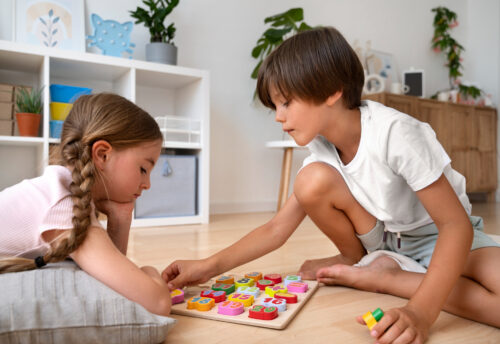
One of the key elements of the Montessori method is the adaptation of learning to the individual needs, the child's current stage of development and capabilities. Each child is allowed to work at his or her own pace and is free to choose the type of work, place and position in which he or she wants to work. There is no „settling” of children, no prohibition of movement or contact with each other. We work on the floor, on a table, on a mat, sitting or lying on our stomachs and - above all - changing positions. This organization of learning fosters the development of independence and promotes a healthy sense of self-worth. Children learn to plan their own time, organize their work and make decisions independently, which provides a solid base for effective functioning later on in the school system as well, where more and more autonomy is required of students.
Development of self-reliance and responsibility
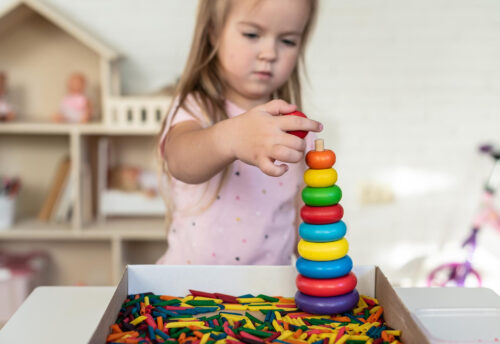
In a Montessori preschool, children learn to make decisions and take responsibility for their actions from an early age. For example, children themselves choose the developmental materials they want to work with, which builds their planning skills and persistence in completing tasks. In our kindergarten, older children summarize their week's work in an organized way, at weekly tea meetings, checking whether they have achieved their goals and planning their work for the following week. Such self-reliance and encouragement to children at the earliest stage of their education helps them later find their way in the demands of school, where responsibility for learning gradually shifts to the student.
Children from Montessori kindergartens often stand out for their ability to concentrate, self-discipline and perseverance in solving problems. We get a lot of information from parents of our graduates that the beginning of elementary school was very pleasant, stress-free for their children, and the transition to school education went smoothly and satisfactorily. A good early education can work like a vaccine, even if the child ends up in a less supportive and more difficult school-age environment. Montessorian children can sometimes be a challenge for early childhood teachers, as they already have the material from grades 1-3 largely mastered, and in many aspects their knowledge far exceeds the core curriculum. For a good teacher, of course, this is an exhilarating challenge that allows him to spread his wings and plan attractive, boredom-free classes adapted to the child's level.
Preparing a child for school and social competence and group work
One of the distinguishing aspects of Montessori preschools is working in mixed-age groups. Older children help the younger ones, which develops their empathy, ability to cooperate, and leadership and mentoring skills. In turn, younger children learn from their older counterparts, which builds an atmosphere of mutual respect and trust. Such experiences are invaluable in the process of adaptation to a new school environment, where children have to function in a class team that is diverse in terms of competence and stage of development.
Development of cognitive skills
The Montessori method places great emphasis on the development of skills such as concentration, logical thinking, mathematics, creativity and problem solving. Working with materials that are designed to encourage exploration and discovery develops children's curiosity about the world and motivation to learn. Montessori children are often better able to cope with the demands of school because they are able to seek out solutions on their own and absorb new knowledge effectively. They also have a solid foundation of mathematical knowledge, built in a completely different way than in conventional teaching methods. They understand mathematics more deeply, they have grasped it multisensorially, not abstractly, and on this basis it is easier for them to superstructure further arithmetic or algebraic skills. Perhaps even more importantly, they are not afraid of mathematics and are not alienated from it, they associate it with exciting games, working with large numbers, they understand the relationships between numbers, quantities, proportions and are skilled in arithmetic operations.
Approaching science as a process of discovery
In Montessori education, children learn through experience, which allows them to gain a deeper understanding of the world around them. Instead of the traditional approach of giving, memorizing, and reproducing information, Montessori encourages experimentation, examination, testing, and independent investigation of results. This approach develops children's passion for learning, which is crucial in elementary school, where active participation in the learning process is required, but most importantly - it's crucial in life!
Preparing a child for school - the importance of a prepared environment
The prepared Montessori environment is orderly and adapted to the child's needs, which promotes the development of self-discipline and organizational habits. In such an environment, the child learns that every activity has its place and time. These skills are invaluable in a more organized school system, where the demands for punctuality and order are much greater.
Adaptation to the evaluation system
In Montessori kindergartens, children are not graded, and Montessori materials include what is known as "error control," which allows the child to check on his or her own whether he or she has handled the task and possibly try again. The role of the Montessori teacher is not to point out mistakes to the child, to judge, to correct. The teacher is an observer, a friendly guide, a support, not a strict omniscient judge. Instead of focusing on grades and the desire to please the teacher, children learn to appreciate their own progress and work independently and persistently on areas that need improvement. They feel true satisfaction with their work and their development, their intrinsic motivation, an evolutionarily valuable equipment of our species, flourishes. There is no better foundation not only for so-called school success, but above all for something far more valuable: mental health.
Let's note that, at least in the declarative layer, the Polish education system tries to draw on current knowledge of the human way of learning or motivation and prescribes a descriptive grading system in grades 1-3. The abandonment of numerical partial grades is legally possible throughout education and actually holds firm only in the least progressive schools, partly, unfortunately, under pressure from the parent community. By sending our Montessorian, manipulation-resistant, independent and self-conscious children to schools, we are influencing how these schools operate, changing them for the better. And this change is happening right before our eyes. Even if a Montessorian child finds himself or herself in a school with a so-called "traditional" grading system, he or she will easily adapt to the new conditions, no prior training is required in any way.
Preparing a child for elementary school after Montessori preschool education - summary
The Montessori method is a holistic, scientifically based educational approach that promotes the all-around development of the child, preparing them for the challenges of life and education. Through an individualized approach to learning, the development of independence and responsibility, social competence and a strong emphasis on comprehensive academic development, Montessori children are more than well prepared to enter the school world.