

What does a day at a Montessori preschool look like?
Everyday life at the Montessori preschool is characterized by a unique approach to development and education, with every element of the day aimed at fostering independence, developing creativity and building children's social skills. Our structure of the day is quite fixed, but at the same time flexible. We adapt it to many factors: the weather, the season, special events, and even the mood of the children. Sometimes they have more energy, sometimes they need more tranquility and calm.
Morning in a Montessori kindergarten
The day at the Montessori preschool begins with the teachers quietly greeting the children. Teachers greet each child individually, creating an atmosphere of respect and trust. The children independently remove their jackets and shoes, hang up their belongings in their lockers and prepare for an eventful day. For the children's down time and morning start-up, we offer them art activities. Such activities are good for warming up their hands, which will have a lot of work during the day, but also ease the transition from the home world to the preschool world. An attractive activity involving colored pencils, scissors or scented plastic mass makes it easier for even the more reticent and sensitive children to get into the daily rhythm.
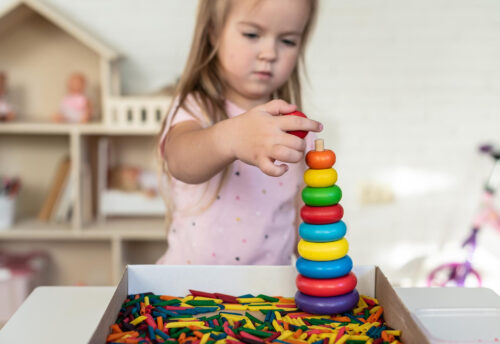
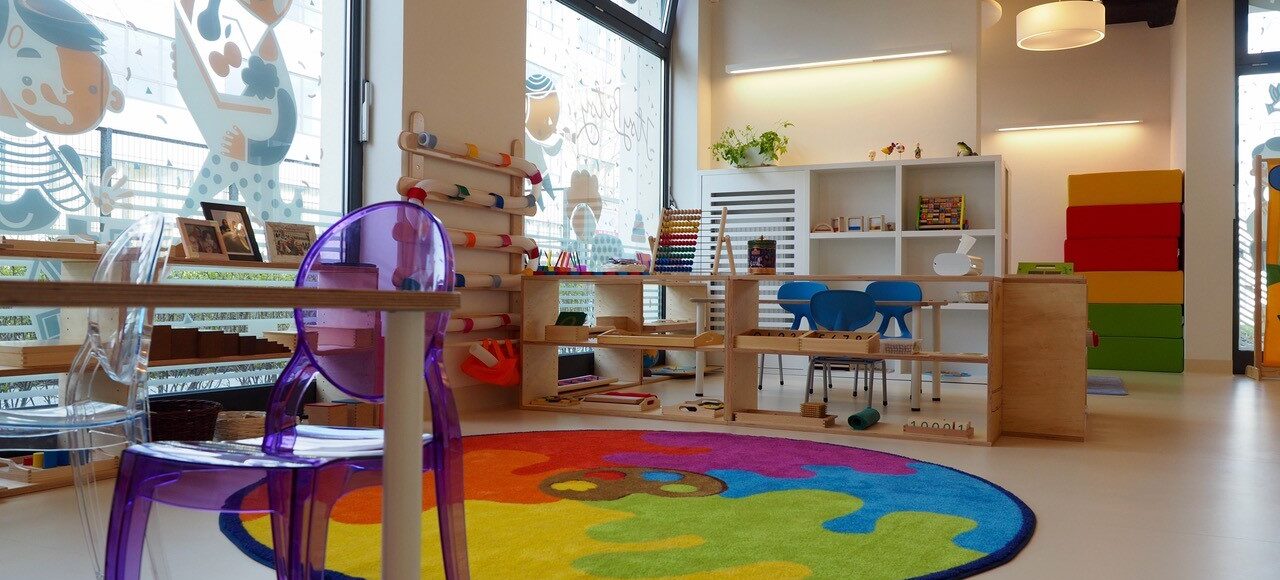
Around 9 o'clock the most important part of the day begins: Montessori self-work. Children are free to choose their activities, and this freedom and freedom of choice is one of the cornerstones of Montessori pedagogy. The prepared environment, in which everything has its place, supports the children's independence. Each developmental material is carefully selected by teachers to encourage exploration and independent action. Children can choose from a variety of Montessori materials tailored to their current interests and developmental needs. Teachers fulfill many roles during this time.
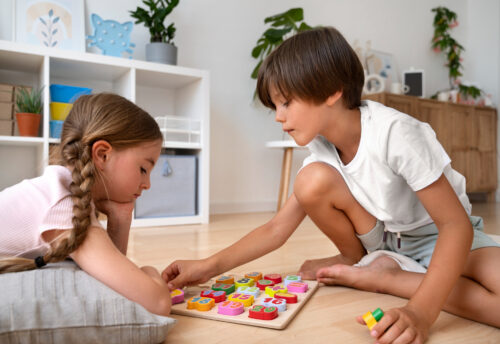
First, they observe and provide assistance when needed (confusion, lack of ideas for work, frustration). Second, they give regular presentations to the children, teaching them to use new and more advanced Montessori aids. And third, they check what stage the child is at, plan the next developmental steps for them and devise ways to support their strengths. Children are not „steadied” at any point in the day. They can walk, move, lie on the carpet. The only rule is to respect the work of others - we don't disturb each other with noise or violations of personal space. You can join another child or group of children working with aids, but only with their permission.
Learning through experience
The time allotted for self-work in a Montessori facility must not be less than 3 hours and must not be interrupted. The children's developing concentration does not tolerate distractions and interruptions. Self-work time in our preschool is therefore sacred. We make sure that everything is conducive to focus. Each child works at his own pace, choosing tasks that are interesting and motivating for him.
One of the elements of self-work is the breakfast buffet. The children have access to food and drink, and when they feel the need, they sit down at the table, put on their chosen dishes, make sandwiches and eat quietly. Independence at the table and awareness of the needs of their own bodies are at least as important to us as working with big numbers on a Montessori bank. Montessori pedagogy emphasizes learning through experience. Children learn by manipulating materials and discovering the rules of the world on their own.
Play as an integral part of learning
In a Montessori kindergarten, play is not separate from learning - it is an integral part of it. Out of respect for children, Maria Montessori called their activity work. In this way, she wanted to emphasize that the child puts effort into his own development all the time. Both when he plays house with other children, arranges a Roman arch, learns to write, jumps, spins in circles, sings or washes the table top.
Play, called work with us, does not mean wasting time, but is a tool for development. Children learn about the world around them, develop manual skills, motor coordination and communication skills. Group play builds cooperation skills, develops empathy and teaches problem solving.
Let's go outside!
After intensive hours of self-work, there comes a time to release accumulated energy. We go outside regardless of the weather. It's a time for running, swinging, burrowing in the sand, but also collecting caterpillars or watching snails. Time outside is very important to us. We come back tired, sometimes dirty and wet. Proper clothing is a must. When we return from the court, we undress, wash our hands and sit down at the table. This is the time for lunch.
Meals at a Montessori preschool
Meals at a Montessori kindergarten are not only a moment to satisfy hunger, but also an important lesson in self-reliance and culture. Children participate in meal preparations, set the tables, and clean up after themselves when they are finished. This is an important part of the day, as children learn responsibility for shared spaces. During meals, children have the opportunity to put food on their own, which helps develop motor coordination and planning skills. Teachers make sure that meals are not only healthy, but also an opportunity to learn to listen to their bodies, as well as to respect others. We take care of the atmosphere at mealtimes, free quiet conversations, peace and tranquility.
Everyone eats as much as they want and what they choose from the prepared dishes. If you expect to spoon-feed your child, urge him to eat more or have rules like: you won't eat, you won't get up from the table, we are not the place for you. We respect children and their feelings. We are happy to give an example of how to compose a healthy plate and show by our own example that broccoli is delicious, but we will not make it a condition for getting dessert.
Afternoon time
An afternoon at our kindergarten is a time for reading books, relaxation, free play and activities to develop interests. You can take part in chess games, you can dance or calligraphy. Whatever one likes. Or you can not participate in any extra-curricular activities and play with friends, lie down in peace with a book or listen to music (and how, classical, it is Montessori after all:)).
Ending the day and preparing for the next day
The day at the Montessori kindergarten ends quietly, with a summary of the activities that took place during the day. Together with the teachers, the children clean the rooms, putting the materials away. This is a moment to reflect on what they have learned and prepare for the next day.
In a Montessori preschool, each day is different, but at the same time based on a fixed structure that provides children with a sense of security. Through daily rituals, children learn organization, independence and cooperation. Each element of the day is designed to support their development, both emotionally and intellectually.
Summary
In a short article we will not include all the nuances of our work, and there are really many of them. Anyway, we do not want to give away all our secrets and rituals that we have developed over the past 10 years:). The structure of the day at Montessori kindergarten varies slightly depending on the age of the children, the season or, for example, because of upcoming holidays or celebrations. If you want to get to know us better and perhaps join our community, call and arrange a meeting. It doesn't cost anything, and it's fun and can make a big difference in your life. Feel free to contact us today!