

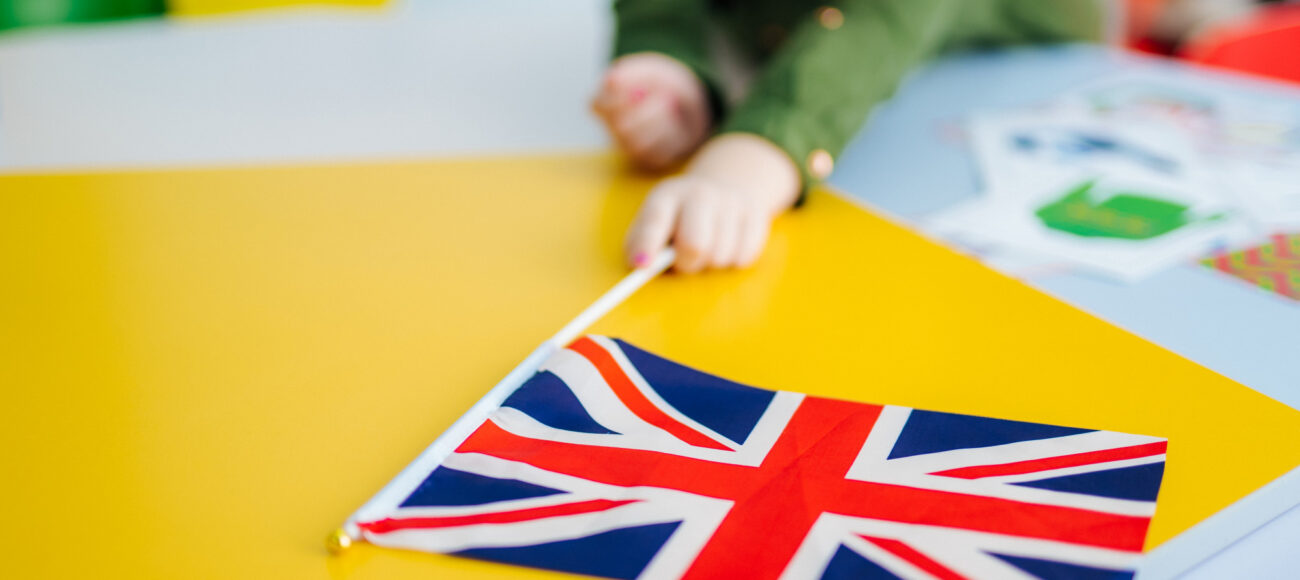
What is language immersion in Montessori kindergarten
In today's global world, the ability to speak more than one language is extremely valuable, perhaps even essential. It's hard to feel at home in the global village when our only linguistic tool is our native language, which is not particularly useful communicatively on a global scale. Without a doubt, the lingua franca of the modern world is English, hence for most parents it is the first and obvious choice when deciding on the educational path of their even very young children. Language immersion is an effective, natural and unforced teaching method that allows children to immerse themselves in a new language, enabling them to learn a new competence smoothly, effortlessly. Montessori preschool ItsyBitsy has been using this method to teach English for 9 years, achieving excellent results with children. This article outlines what language immersion is, how it is used in a Montessori educational facility environment, and the benefits it brings to the children at our preschool.
What is language immersion?
Language immersion is a teaching method in which children are immersed in a foreign language throughout their time in kindergarten. Unlike conventional methods, where language is taught as a separate subject, in short „sessions,” in immersion the language becomes a natural means of communication. Children learn through daily interactions, games and activities that take place exclusively in English. This makes the learning process more like natural language acquisition. Just as it happens in bilingual families.
Pillars of the Montessori method
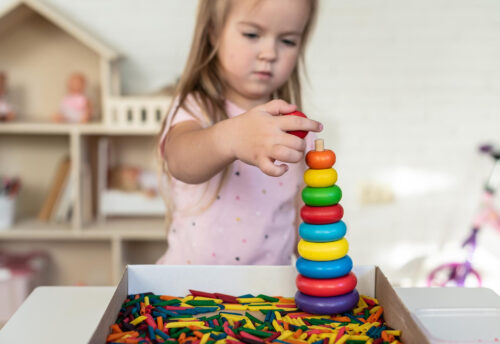
The Montessori method, created by Dr. Maria Montessori, an Italian physician, educator and anthropologist, is based on respect for the child, individualized attention to the child's needs and learning through concrete, hands-on activities. In Montessori preschools, children are free to choose their activities, which promotes their independence and the development of creativity. Teachers act as guides who support children at their own pace of learning and closely observe what new material the child is ready for. In such an environment, children have the opportunity to develop not only academic skills, but also social and emotional skills.
Sensitive phases according to Maria Montessori and the receptive mind
Maria Montessori noted that children up to the age of 6 go through so-called receptive phases, which are periods of special susceptibility to learning certain skills and behaviors. One of the most important features of this period is the so-called absorptive mind, which allows children to assimilate knowledge almost organically, without conscious effort. Young children are straightforwardly made for absorbing knowledge and acquiring new competencies, and establishments in the Montessori movement do everything to make the most of this time.
During this period of their lives, children learn through direct experience and interaction with the environment, which makes language imersion particularly effective and meaningful. It is thanks to their receptive minds that children are able to acquire more than one language at a time, which is, by the way, a natural consequence of raising children in bilingual families. Montessori emphasized that early language education is not only possible, but even natural and in accordance with children's biological predispositions. There are now more and more voices of researchers indicating that early teaching of even three languages does not exceed children's capabilities and does not negatively affect their rate of language development. In the initial period of acquiring linguistic competence in more than one language, the phenomenon of language mixing may appear, but it disappears spontaneously at subsequent stages of development and does not leave negative consequences.
Language immersion as part of daily routine
At our ItsyBitsy preschool, language immersion is an integral part of the daily routine. Children participate in a variety of activities, such as art, music and movement classes, or daily conversations with teachers, which take place exclusively in English. Self-work, the clou of a Montessorian day at the preschool, takes place in both languages, Polish and English, depending on which teacher happens to be working with the child. English-speaking teachers support the children, adapting their messages to each child's level of language proficiency, allowing for a smooth introduction of the foreign language into daily preschool life.
The role of English-speaking teachers in our kindergarten
Children in our kindergarten know very well that in each group one of the teachers does not speak Polish, and his native language is English. If they want to communicate with him - and they do, because this person offers this many engaging activities - they must try to use English. At first, gestures and body language (and older colleagues!) come to their aid, but over time communication becomes more verbal, natural and casual. Teachers know how to dare children to interact with them linguistically, and are not in the habit of correcting mistakes or pointing them out, instead they are willing to repeat correct and appropriate phrases many times to help solidify them. Maria Montessori, and modern neurodidactics behind her, teach us that it is contextual, practical, useful learning in the here and now that is natural to the human species and creates more durable memory traces.
Examples of language activities
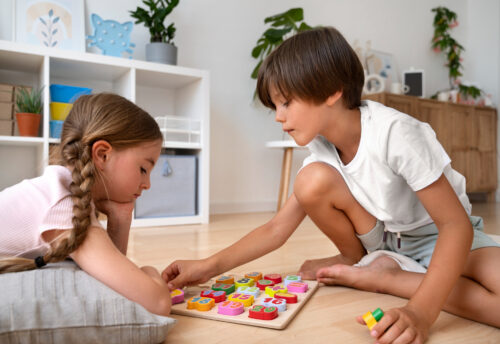
Examples of language activities in our preschool include circle time meetings, where children learn songs, rhymes and participate in language games, but learning takes place all the time: at meals, brushing teeth or playing outside. All these activities are designed in a way that promotes the natural development of language skills. At the same time, it is enjoyable and engaging for children.
Starting in the 2024/25 school year, we are also starting cooperation with the British Council and introducing the preparation of the oldest preschoolers to face their first YLE Cambridge language exams. We want eager children to have the opportunity, in a pressure-free and tension-free atmosphere, to test their language skills acquired during their preschool years and receive their first Cambridge certificate. Six-year-old children will therefore be provided with additional language classes during the day in the kindergarten aimed specifically at translating their knowledge and skills into the competencies tested in the exam.
Benefits of language immersion at Montessori ItsyBitsy preschool
Language immersion at Montessori ItsyBitsy preschool brings a number of benefits. First of all, children develop language skills, learning English naturally and without stress. Numerous studies show that children who learn languages at a young age have better cognitive abilities, greater flexibility of thinking and better memory. In addition, language immersion promotes social and emotional development as children learn to cooperate, empathize and communicate in a new language.
Long-term, children coming out of our program have a solid language foundation that makes it easier for them to continue learning languages in the future. Immersion at a young age can also positively influence their perception of other cultures, making them more open-minded and tolerant. In our kindergarten, language education is always combined with learning about geographically distant cultures, primarily those from which our English-speaking teachers come (USA, South Africa, India, UK and others).
How to choose a Montessori preschool with language immersion?
When choosing a Montessori preschool with language immersion, it is worth paying attention to several key points. First of all, it is important that the program is run by teachers who are experienced in teaching foreign languages to young children and have mastered the language themselves to a proficient degree. It is good if it is their native language or one of their two native languages. In our opinion, mastery of the language at B1 or B2 level is not sufficient, although allowed by Polish regulations. It is also important to check whether the kindergarten uses the authentic principles of the Montessori method and whether language immersion is an integral part of the program and not just an add-on or advertising slogan. Half-hour language classes, even daily, have nothing to do with language immersion and intended bilingualism. It's also a good idea to talk to parents of children attending a particular kindergarten to get their opinions and experiences.
Summary
Language Immersion at Montessori ItsyBitsy Preschool is a proven and effective method of teaching English that has numerous benefits for children. Through language immersion, children learn in a natural and enjoyable way, while developing their cognitive abilities and social and emotional skills.
We invite you to contact us to learn more about our program and the benefits of language immersion, intentional bilingualism and the Cambridge certification program for young children.