

The Montessori method in a nutshell. How does the method work at ItsyBitsy?
The Montessori method is an educational approach that has been recognized by professionals and parents around the world for more than a century for its beneficial effects on children's development and respect for their dignity and individuality. Developed by Italian physician and educator Maria Montessori, the method focuses on each child's individual needs and abilities, supporting their natural development. Montessori ItsyBitsy Preschool proudly implements the principles of this method in its daily work with children, creating an environment that fosters independent thinking, creativity, mental health and joyful discovery of the world. See our article about the Montessori method in a nutshell.
History and philosophy of the Montessori method
The Montessori method originated in the early 20th century, when Maria Montessori, an Italian physician, engineer and educator, opened her first school, Casa dei Bambini, in Rome in 1907. Her approach was revolutionary. Instead of the administered method of imparting knowledge and requiring children to reproduce what the teacher handed down, Montessori allowed children to discover truths about the world on their own by working with specially prepared materials. The philosophy of the Montessori method is based on the belief that children are inherently curious, eager for knowledge and eager to learn. Development and the drive to discover are written into their DNA. Therefore, it is the teacher's job to create an environment that supports this natural curiosity and allows for free exploration.
The main principles of the Montessori method in a nutshell
The Montessori method is based on several key principles.
Independence
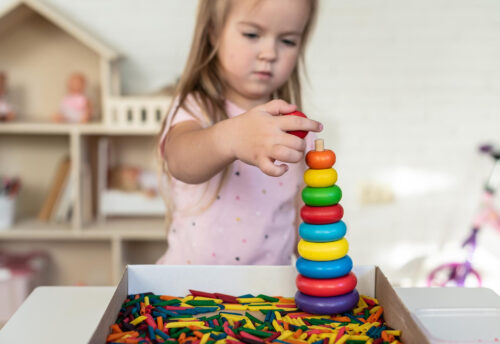
According to Maria Montessori, any unnecessary help is an obstacle to development. Children in a Montessori environment gain successive degrees of independence. This fills them with pride and fosters a healthy sense of self-esteem and gradually builds independence from adults. The teacher provides help and support when needed, but also knows that preschool children have a great need to do things on their own. Montessori pedagogy responds to this developmental need perfectly. Don't always have the time and patience to wait for your child to put on his shoes or jacket by himself? We have this time and patience (and we know various tricks that make learning more pleasant and easier!), so your child will have a chance in the Montessori preschool to learn self-care activities, which will soon simplify your everyday life.
Individualization of learning
Each child works and learns at his or her own pace, and the teacher tailors the presentations to his or her individual needs. Everyone at Montessori follows his or her own path, but the goal is always to improve skills and acquire new competencies in different areas of life.
Prepared environment
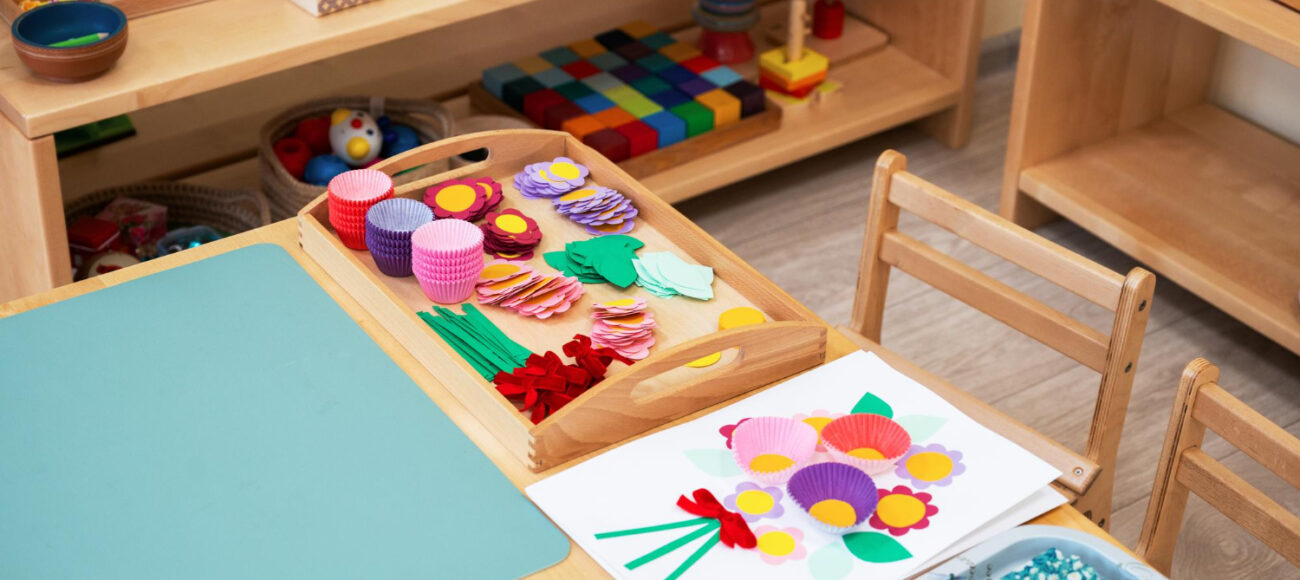
A key element of Montessori pedagogy is the educational environment. It is properly organized and equipped to comprehensively support the child's development. The furniture and materials are tailored to the needs of children in the age range. What's more, children are hosts, not guests, in their preschool room.
Close relationship between movement and cognition
Freedom of movement promotes thinking and exploring. Children are not limited to sitting in desks or at tables. Free movement is written into every type of Montessori self-work.
Selection
Children in Montessori feel their agency. They choose for themselves what, with whom and how they work. Feeling in control of their lives, learning to be free and taking responsibility for their own choices is perhaps Montessori's most important gift to children. The Montessori teacher is a support, a guide, but does not impose his will and does not take away the children's freedom of choice and agency.
Using children's natural interests in the learning process
Different from conventional education, Montessori focuses on developing those interests that children bring with them. Airplanes? There you go - we can deal relentlessly with airplanes, and at the same time educate the senses, learn to count, write and read. Montessori preschools are more like miniature universities or laboratories that encourage independent exploration and make old interests blossom, but also make new ones emerge.
No external rewards and punishments
Maria Montessori observed this, and modern psychology confirms it: all external punishments and rewards are a huge obstacle to learning and development. The intrinsic motivation to develop and acquire knowledge dies in contact with a system of behavioral incentives and punishments. This is usually seen as early as early childhood education, when children lose their enthusiasm and learn to do only what will benefit them or avoid unpleasantness, and forget their passion for learning about the world.
Collaboration
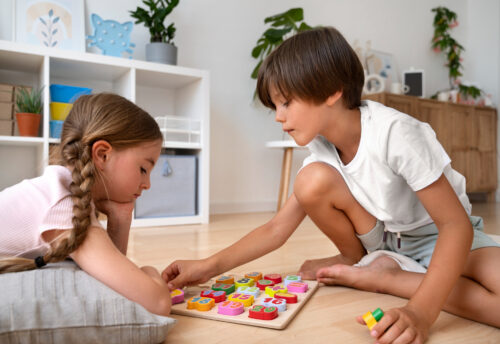
Our species owes its evolutionary success not to physical strength, sharp fangs and claws, but to the ability to cooperate. In a Montessori kindergarten, children cooperate with each other, not compete. Mixed-age groups are conducive to this, because in such groups it is more difficult to compare. Everyone is different and can bring something unique to a given endeavor. Conventional schools often make cooperation difficult or forbid it. In Montessori it is different. You can work with a colleague or colleagues, maybe create projects together, you can support each other, discuss, exchange experiences. We ensure that everyone benefits from such cooperation, learning from others and sharing their knowledge and ideas with others.
Order and rhythm of the day
Preschool children have a great need for order, both in terms of their surroundings and the organization of their time. Montessori responds to this need by providing children with logically ordered materials, attention to their surroundings, an absence of kitsch and ornament overload, and a calm, predictable order to their day. Mickey Mouse on the wall, a huge TV in the classroom and a plastic carpet with Dog Patrol? That's not the case with us. With us, the environment promotes focus, calms you down and shapes good taste!
Application of the Montessori method at ItsyBitsy Montessori Preschool
Montessori preschool ItsyBitsy implements the Montessori method with full commitment, taking care of every aspect of child development.
Above all, we provide a fully prepared environment, in line with Montessori pedagogy. Classrooms are designed to encourage children's independence. The furniture is adapted to their size, and developmental materials - always easily accessible. Care is taken to ensure the quality of materials, their regular rotation and variety. The space is orderly and aesthetically pleasing, which promotes concentration and the development of good taste.
We provide coverage of the full Montessori program at the preschool (Primary) stage, i.e. practical life, sensory education, language (in our case it is two languages - Polish and English), mathematics, space education (here geography, astronomy, botany or zoology is included) and cultural and artistic education.
Our staff is trained in preschool pedagogy and Montessori pedagogy. In addition, they continue to expand their knowledge and competence at numerous courses, workshops and conferences. Regualrly we conduct development processes in the field of Agreement without Violence, learn valuable news from the world of education.
Teachers at ItsyBitsy Montessori Preschool carefully observe each child to understand their unique needs and interests. This allows them to adapt their working methods, offering tasks and materials that address these needs. Children learn at their own pace, which promotes deep and lasting learning.
Children at ItsyBitsy are encouraged to take initiative and perform various activities on their own, from simple tasks to more complex projects. This way of learning builds their sense of responsibility for their own actions, and promotes healthy personality development.
Montessori ItsyBitsy preschool places a strong emphasis on developing social skills. Children work in smaller or larger groups and learn cooperation and mutual respect. Joint projects and tasks teach them how to communicate and interact effectively with others. Parents are also part of our community. They are always welcome with us and participate in various projects, for which we are extremely grateful.
Benefits of the Montessori method for children
The Montessori method has many benefits that have a significant impact on a child's development, as well as his well-being and mental health.
- Development of self-reliance: By being able to perform tasks independently, children learn independence, which builds their confidence and self-esteem.
- Creativity: The Montessori method stimulates children's creativity through the freedom to choose activities and projects that suit their interests. Art is an important part of our program and has a prominent place in the daily schedule.
- Social Skills: Children learn cooperation, communication and empathy, which is crucial for their social development. Montessori is educating for peace; the ability to negotiate, find optimal solutions and simply get along is an integral part of our daily preschool life. And yes, we have our own ways to support children in learning to coexist peacefully with others.
- Academic Skills: Each child learns at his or her own pace by working with real objects, not pieces of paper. This allows for deep and lasting learning. The Montessori preschool program quite significantly exceeds the core curriculum. Maria Montessori observed that children at this age show great receptivity of mind and master with greater ease than older children numerous skills that conventional education reserves for later stages of education. Importantly, no child is forced to do anything in a Montessori environment. We always wait for readiness, the receptive phase to a given stimulus, before entering a higher educational stage with a child.
Most children who have gone through the full program at a good Montessori preschool (from the age of 3 to 6) have well-established literacy skills, perform arithmetic operations on concrete, understand the basics of flat and spatial geometry, communicate in two languages (in the case of bilingual establishments), and have considerable knowledge of the natural and cultural world. But this is not the most important thing. Our greatest achievement is if they remember their time in kindergarten well, have made their first friendships, know how to get along with others and still have the drive to acquire knowledge!
Parents' experiences and opinions
We listen to our children's parents. We learn from their comments. We take constructive criticism into account, and good words from them are the wind for our sails and make us believe in the sense of our actions.
„A very good preschool, where children are cared for by specialists, the Montessori program is implemented, but also a close-knit approach and attention to the individual needs of children.”.
„My two children have been going to the kindergarten for several years - I have always been able to count on professional care and commitment - I know what I am saying because I have a comparison with other institutions. What was important to me is that the Itsy Bitsy team is not there to respond to the needs of the parent, but to the needs of the child. The cooperation with the parent is always a partnership, and the team - always available and open. My kids love going to Itsy Bitsy, I highly recommend it.”
„Itsy Bitsy is a place created out of love for children, with great attention to all details from the organization of the space and equipment to the choice of teachers. Children here get everything they need - attention and involvement of adults, space to develop freely, a sense of security and professional care. I highly recommend!”
For every good word we sincerely thank you, they give us wings!
Montessori in a nutshell - summary
The Montessori method is an approach that has been proven worldwide and for more than 100 years to promote a child's natural development. It emphasizes independence, creativity and social skills. Montessori ItsyBitsy Preschool proudly implements the principles of this method, creating a welcoming and stimulating environment for children. We encourage parents who are interested in this form of education to contact us. We will be happy to answer all your questions and help you understand how the Montessori method can support your family. Call or write and schedule a familiarization meeting at our preschool.