

The Pink Montessori Tower - the most recognizable material in Montessori education
The Pink Tower is one of the most well-known and respected developmental materials in the Montessori method. You can find it in every Montessori preschool classroom, all over the world. Interestingly, this material was personally designed by Dr. Maria Montessori, in accordance with her vision of educating children in a sensory-based and hands-on way.
What is the Montessori Pink Tower?
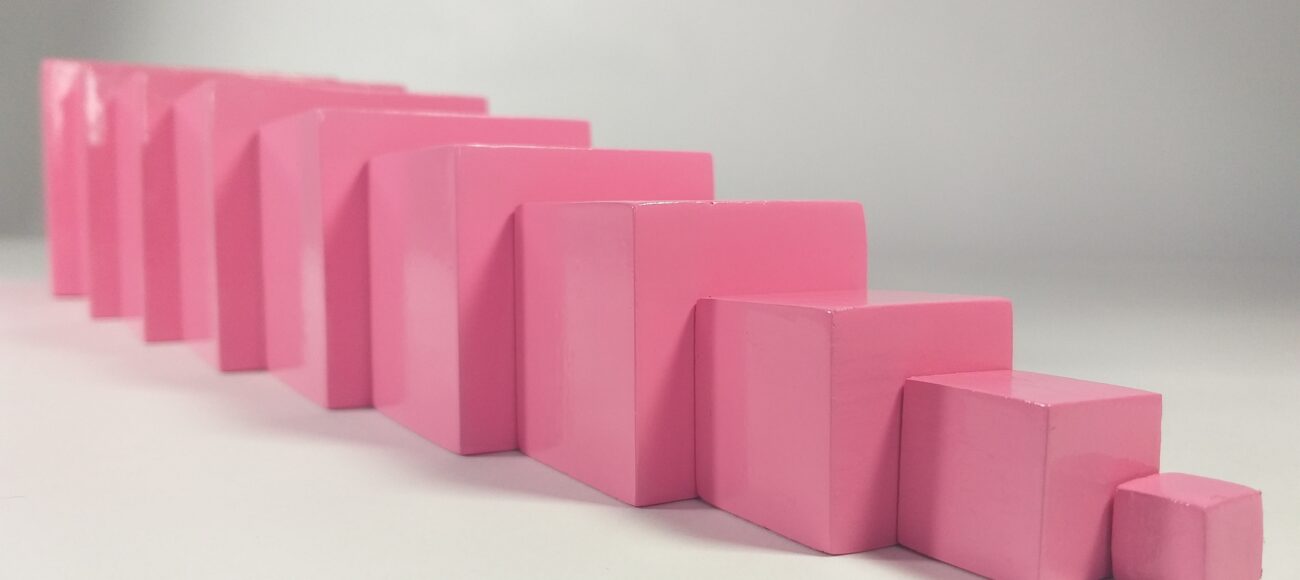
The Pink Tower consists of ten wooden cubes of different sizes - from the smallest of 1 cm³ to the largest of 10 cm³. These blocks increase gradually according to the algebraic series of the third power - this means that the second block has a volume 8 times larger than the first (2³), the third block 27 times larger (3³) and so on. By manipulating these types of objects, the child builds the concept of size in three dimensions.
When do children start working with the Pink Tower?
The Pink Tower is introduced into the Montessori environment when the child is about 2.5-3 years old. It is part of what is known as the sensory area in the Montessori classroom, which aims to develop children's senses and their ability to recognize features of objects. It is important that all Pink Tower blocks have the same color, material, shape and texture - the key feature for the child to focus on is size only.
What skills does working with the Pink Tower develop?
When children begin working with the Pink Tower, usually arranging the blocks from largest to smallest, they notice not only differences in size, but also in the weight of each successive block. Dr. Maria Montessori observed that working with sensory materials allows children to develop perceptual skills - they begin to better understand what they see, feel and touch, which in turn supports the development of their cognitive intelligence.
The Pink Tower also has a great impact on the development of children's fine motor skills. The activity of stacking blocks (especially the smallest ones!) requires extremely precise hand movements, which leads to the improvement of motor coordination. Try to arrange the tower yourself one day neatly and tonally. Not only is it not trivial, but it quiets the mind and can be an almost meditative activity.
The Pink Tower and the development of language and mathematics
Although the Pink Tower is a sensory material, it also has a direct impact on children's development of language and math skills. Children learn concepts related to size, such as „big,” „small,” „bigger,” „biggest,” and working with the blocks prepares their hands for writing, as it allows them to use a three-finger grip. The Pink Tower introduces concepts related to the decimal system, geometry and abstract mathematical concepts such as volume and cube root.
Why is the Pink Tower pink?
Dr. Maria Montessori experimented with different colors to see which ones best attracted children's attention. It turned out that it was the color pink that most intrigued the little explorers.
Maria Montessori and her passion for mathematics
Maria Montessori, although she was primarily a psychiatrist and educator, had first and foremost a scientific mind and loved and understood mathematics. For this reason, many Montessori materials, such as the Pink Tower, are based on precise proportions, logical formulas and mathematical principles. Montessori knew that math is the key to understanding the world, and that experiences from the senses are the basis for developing children's math skills. This is why mathematical and sensory materials are at the heart of Montessori pedagogy, helping children naturally discover the rules governing the world around them.
We are here for you, welcome
If you would like to see how Montessori pedagogy can support your family in the holistic upbringing of your child and building his/her mathematical competence, we invite you to contact us. We will be happy to schedule an appointment and answer any questions or concerns you may have.