


10 Montessori principles and how do we follow them at ItsyBitsy?
At Montessori ItsyBitsy preschool, we implement the full Montessori program provided for the preschool stage, that is, for children aged 3-6/7. Maria Montessori created the first holistic pedagogical system based on scientific observation of how children learn. It has been subjected to intensive testing and refinement over the past nearly 120 years and has passed this test of time victoriously. Read on and check out Montessori's 10 principles, and whether the pillars of our work are in line with your family's beliefs and values.
Rule #1: Respect the child
Respect for the little human being and taking him seriously lies at the heart of the Montessorian approach to building relationships with children. We show this respect in our nursery from the very first moments, that is, from the arch-important process of adaptation. For a child, the transition from the wings of his parents or even from an already tame nursery environment to a completely new place and under the care of completely unfamiliar people, is a major life change. With us it happens without haste, compulsion and unnecessary nerves. The first days or weeks the parent, grandmother or caregiver spend with the child in the institution. The timing of the transition to the next stage, i.e. the caregiver's departure from the nursery for a short time, depends on the readiness of both parties - the child and the caregiver. We always adjust the strategies and pace of adaptation to the needs and sensitivity of the little person. And it works out really well for us! In kindergarten life, respect for children manifests itself in providing them with freedom of choice of activity, no punishments or rewards, taking their emotions seriously and seeing them as hosts, not guests of the kindergarten.
Principle #2: No punishments and rewards, foster intrinsic motivation
Maria Montessori was herself surprised by her discovery. Her ability to carefully observe children led her to the conclusion that any external interference in the form of punishments, rewards, reprimands or praise from adults destroys children's innate motivation to develop, learn and self-improve. At a later stage of learning, this manifests itself in a reluctance to engage in „non-graded” activities. Dr. Montessori wrote:
„Like others, I believed that in order to instill a spirit of work and peace in a child, it was necessary to encourage it through some kind of external rewards that would flatter its meaner feelings, such as gluttony, vanity or selfishness. I was deeply amazed when I discovered that a child who was allowed to learn rejected these lower impulses. At the time, I urged teachers to withdraw the use of these common rewards and punishments, which had long since ceased to be suitable for our children, and to narrow their action to gently directing these children to work that is appropriate for them.”
Maria Montessori's insights are now supported by an overwhelming mass of psychological research findings. Children love to learn, to learn new things, to develop their interests, they are straightforwardly designed for this. In the Montessori system, intrinsic motivation flourishes. And we at Montessori ItsyBitsy preschool look at it with great pleasure and satisfaction. Give your child the chance to flourish academically, emotionally and socially surrounded by people who understand their needs.
Rule #3: Uninterrupted cycle of self-work
Problems concentrating, planning work and finishing it? Perpetual procrastination and jumping from task to task? Distraction and frustration? Sounds like the scourge of our times... Supported, moreover, by the conventional education system, in which children, under the dictates of an adult, must shift their attention from one activity to another, even when they have not completed the previous work. Children in the Montessori system are taught a different approach from the beginning, full of attentiveness, focus and wise and independent planning. The morning cycle of self-work, when no one disturbs the children from choosing an activity and devoting themselves to it for any length of time, is conducive to learning to focus, deepen their knowledge and expand their skills. Children at Montessori ItsyBitsy preschool are provided with a proper, uninterrupted cycle of self-work, a huge variety of aids and materials to use, and helpful adults to support them when they get lost or direct them to increasingly challenging tasks.
Rule No. 4: Individual approach
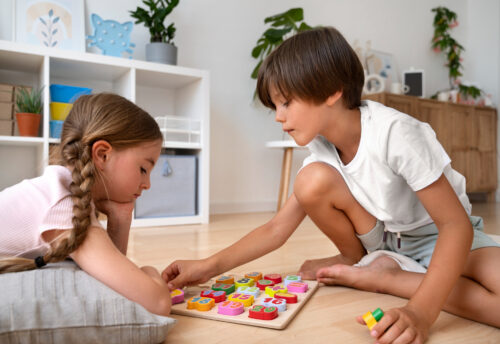
In Montessori pedagogy, the individual approach is the default, it is no pedagogical novelty. Everyone works at their own pace, the individual needs and interests of each child are respected. In a group of mixed-age children it is difficult to compare, it is difficult to race and compete. Everyone is different, everyone is unique, and everyone finds a place for themselves. Children in a montessori group work individually or in small, freely formed groups. In our kindergarten, we promote cooperation and give all children the opportunity for comprehensive development.
Rule #5: An environment tailored to the child
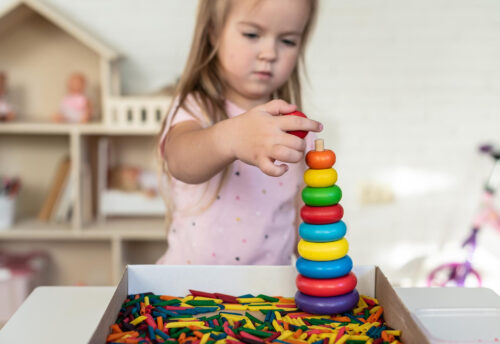
The so-called prepared environment is one of the cornerstones of the Montessori system. In a Montessori kindergarten, all materials are within the reach of even the youngest members of the group. The child is not dependent on constant help from adults. And there is no boredom. The shelves are full of regularly changed developmental materials from different areas (daily life, sensory, languages, mathematics, space education/culture). Today it's hard to believe, but it wasn't always like this in children's centers!
Adapting the size of furniture to the height of children is precisely the work of the young doctor Maria Montessori, who undertook her work first with the neglected children of a psychiatric ward and then with the healthy but poor children of the Roman streets. Prior to her reforms, children in schools and kindergartens used ordinary furniture, which meant that their feet dangled from their chairs and their work materials were often too high for them to reach. At the Montessori ItsyBitsy preschool, the children are the hosts in their classrooms. They take care of them, watering the plants, taking care of the animals, keeping the shelves in order. This gives them a sense of agency and self-confidence and equips them with key life skills.
Principle #6: Freedom of Choice
Freedom is a concept that in the Montessori method is changed by all cases. At the same time, it is worth remembering that freedom in a Montessori kindergarten is not anarchy and arbitrariness. On the contrary, we have a lot of reasonable, adapted to the needs of children structure and regularity. We understand children's freedom as their fundamental right to respect for their dignity and independence, but also as their obligation to treat the freedom of other children and adults with respect. Respect for children's boundaries is the best way to learn coexistence. At Montessori ItsyBitsy preschool, children themselves choose the activity they want to engage in that day. Their freedom is limited by only a few factors, such as the availability of a particular aid (another child may have chosen it earlier and it is necessary to wait for their turn) or their readiness to work at a given level (advanced aids require going through several earlier stages under the guidance of a teacher). Natural, not artificially imposed restrictions are in themselves an excellent way of learning to live peacefully in society.
Rule No. 7: Independence
All unnecessary help is an obstacle to development - this paraphrase of Maria Montessori's claim you will hear from us more than once. Children love to do things themselves! Me alone! Me alone! Preschoolers don't want to be cranked out, they want to be able to try and make mistakes, get it wrong and try again. Adults are around to help when needed, but they don't do the children's job. You will be surprised how quickly your children will learn to dress themselves, make sandwiches or wash the table after eating at our preschool. These are not trivial skills, and for children they are milestones in their development!
Rule #8: Observation
A Montessori teacher is not a judge of grades and judgments, not a lecturer standing on a lectern and not an often disregarded ‚kindergarten teacher’. He is, above all, a reasonable, well-prepared observer who „reads” the child and understands his needs. In our kindergarten, everyone undergoes courses and training in Montessori pedagogy and understands their role well. A wise observer notices a child's sensitive phase (for example, learning to write) and suggests appropriate activities at the right time. The role of a Montessori teacher is difficult and demanding, but it is also extremely rewarding. It is also important for parents that the Montessori teacher will share specially prepared observations with them at regular intervals. He or she will also help capture and support the child's strengths and address any difficulties.
Rule #9: Self-discipline
Maria Montessori was against disciplining children with punishments and rewards. Today, punishments are often disguised under the term „consequences.” Currents like „positive discipline” are just that masking a purely behavioral approach to raising children. Real consequences are the natural consequences of events, not the actions taken by adults when an event occurs. Thus, for example, the consequence of spilling water on the floor is a wet floor and no water in the cup, not a parent taking the cup away (even when „warned” to do so, it is still simply a punishment, not a consequence).
At Montessori ItsyBitsy preschool, we confidently implement a key element of Montessori pedagogy. We focus on self-discipline and adult modeling of behavior. You won't find „motivational” boards, stickers or stamps with faces denoting reprimand or praise. There is also no seemingly innocent blackmail and promises of „something for something.” No labeling of children as „polite” or „naughty” with us. As a result, do children „do whatever they want,” learn nothing, destroy their surroundings and disrespect each other or adults? The opposite is true.
Rule No. 10: Space education
Space education is one of the sections into which the Montessori preschool program is divided. Under it is hidden knowledge of the natural world and culture. It includes content from biology, as well as geography, physics, astronomy or art. The Montessori program goes far beyond the framework of the core curriculum for kindergartens and allows children to freely explore different areas of science. A hugely important role in our program is played by education for peace, i.e. learning to build relationships based on respect and empathy, and ecology. Maria Montessori considered love of nature and respect for other species and natural resources as key values to be passed on to children. For:
„A child who has truly loved his environment and all living creatures, who has discovered joy and enthusiasm in his work, gives us reason to hope... Hope for peace in the future.”
This hope again, as in Mary's time, is necessarily necessary for us.
10 Montessori principles - summary
Montessori ItsyBitsy Preschool bases its activities on the principles of Montessori pedagogy, which support the holistic development of the child. Among the key principles are respect for the child, abandonment of behavioral mateods in favor of fostering intrinsic motivation, an uninterrupted cycle of self-work, and an individual approach to each student. The kindergarten provides a tailored environment for children, freedom of choice, independence and support in developing self-discipline. Teachers act as observers. They support children in their natural development. The educational pprogram also includes space education, a broad introduction to the natural sciences and humanities. Our approach helps children develop academically, emotionally and socially.
Feel free to contact us!
Call or write to us, make an appointment with the management and see if we are the right place for your child.