

Emotions in children - how to talk to a child in the Montessori spirit?
Emotions are an integral part of humanity. And childhood especially! A child is made up of emotions, in addition, they are intense, changeable, often difficult to name and understand, both for the children themselves and for the adults close to them. For parents and caregivers, their manifestations can be baffling, sometimes frustrating and even disturbing. Meanwhile, for wise educators, inspired by the achievements of the greatest development specialists, including Maria Montessori, a child's emotions, like his curiosity about the world or his need to move, are a natural and desirable manifestation of development.
Emotions in children - what is worth understanding?
The Montessori philosophy encourages an approach full of attentiveness, acceptance and respect towards all emotions - both easy, pleasant ones and difficult ones, such as anger, anxiety or frustration. In this article, we'll look at how to support a child's emotional development in the Montessori spirit, and how to have conversations that will help your child better understand himself and others. You'll also find specific tips and examples of how to talk to your child about emotions in a supportive and empathetic way.
A child's emotional development is gradual but non-linear, with spikes and even periods of storm and stress. Emotional development takes time, experience and adequate support. Young children feel emotions very intensely because their nervous system and brain structures responsible for self-regulation (e.g., the prefrontal cortex) are still very, very immature. A child can go from euphoria to despair in a matter of moments - and this is perfectly natural.
From a Montessori perspective, every child is competent - they have the potential to learn to recognize, express and regulate emotions, but they need the right guidance and loving support to do so. The key is to understand that emotions are neither good nor bad - they just are. The adult's job is not to suppress them, but to accept and support the child in experiencing them.
The role of the adult in Montessori's approach to emotions
In Montessori pedagogy, the adult does not act in the role of managing the child's emotions. Rather, he is a companion, an observer and a support - someone who creates space for emotional expression and helps the child build a vocabulary of emotions. A child who cries, screams or withdraws silently needs not to be chastised, felt up or soothed at all costs, but to have the safe presence of an adult who will accept his condition and help him find himself in it.
The self-awareness of the caregiver is key here - if he himself cannot recognize and regulate his emotions, it will be more difficult to support the child. That's why it's a good idea to start with yourself: notice your reactions, name your emotions, take care of inner peace and order. A self-aware adult is a safe haven for the child.
How to talk to your child about emotions - practical tips
Talking about emotions can become a daily ritual and a way to deepen your relationship with your child. Here are some proven tips inspired by the Montessori spirit:
- Name the emotions you see - „I see that you are very sad. You are crying - something must have made you very sad. ”Such messages help the child identify emotions and teach him emotional vocabulary. They give space for self-reflection and do not judge.
- Reflect feelings, don't judge -. Avoid saying: „There is no reason to cry” or „Don't overreact.” Instead, show that you accept your child's emotions as they are: „It must have been very difficult for you.”
- Ask questions to support reflection - „What happened that made you feel that way?”„Do you want to talk about it?”„What do you think could help you now? ”This encourages the child to find solutions on his own and teaches him that emotions can be tamed and understood.
- Avoid comparisons and pressure - Statements like „See, Susan doesn't behave like that” or „Big kids don't do that” can embarrass the child and block openness. Every child experiences emotions differently - it's not a race.
- Use simple, calm language - Avoid moralizing. Children learn by imitation, not by lecturing. If you want your child to talk about his feelings, talk about yours: „I'm tired today and need a moment of silence.”
Environments that support emotions in children
Montessori emphasizes the importance of a prepared environment - and this applies not only to developmental or educational materials, but also to the emotional climate. The space in which the child resides should promote a sense of security and inner order. Calm colors, the absence of flashy decorations, order in the environment, and access to one's own corner (tent, canopy bed, etc.) can support emotional regulation.
Specific tools can also be helpful:
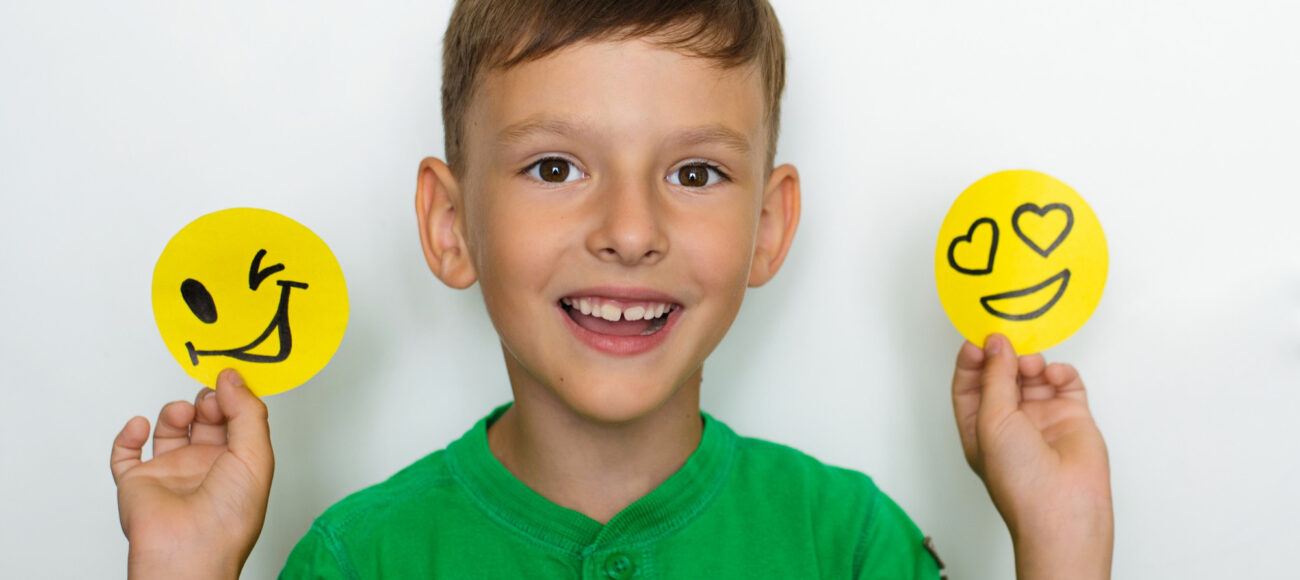
- Emotion cards - pictures depicting different emotional states, which the child can choose, analyze and name.
- Books about emotions - short, simple stories that help understand different feelings. The market offer is now very rich, but the mainstream is still dominated by books that promote the suppression of emotions by, for example, „being brave.” Therefore, literature should be chosen carefully.
- Mirror of emotions - A place where a child can look at his facial expressions and learn self-discovery.
- Sensory bottles or anti-stress balls/nipples - helping to regulate voltage.
Classes with a psychologist in kindergarten - in our kindergarten such regular classes, using a variety of tools (emotion cards, pictures, games, drama, scenes, conversations, creative expression) are already a long-standing tradition and bring really surprisingly good results.
Emojis in children - summary
Emotions are the language of childhood - intense, real, sometimes difficult to understand. In the Montessori approach, we do not aim to „fix” or eliminate them, but to notice, accept and name them. A child who feels listened to and understood builds self-esteem, develops empathy and learns that all emotions are important, that he himself is important and heard.
Talking about emotions doesn't require big words - just presence, silence, an attentive look and a calm „I'm with you.” As parents and caregivers, we have tremendous power - not by controlling, but by accompanying. It is worth using it. Don't fight for control over your child, over your child's emotions, instead keep influence over your child's life - it's priceless for both of you.