

Large motor skills - what is it and how does it differ from small motor skills?
A child's motor development is one of the key aspects of his overall development. There are two main areas of motor skills - large motor skills and small motor skills, which are closely related but have different functions. Large motorics encompasses the movements of the entire body and involves large muscle groups, affecting the child's physical fitness, coordination and overall independence. The Montessori approach places great emphasis on natural movement, free exploration of space and the development of motor skills through everyday activities. Maria Montessori emphasized that movement and learning are closely intertwined, and that a child develops best when given the opportunity to actively experience the world. Let's take a look at what large motor skills are, their importance for a child's development, and how to support their development according to Montessori's philosophy.
What is gross motor skills?
Large motor skills refer to the ability to control the movements of the entire body and involve large muscle groups such as the muscles of the legs, arms, trunk and back. It is a fundamental ability that develops from birth and affects all of a child's daily activities.
Examples of large motor skills:
- Walking, running, jumping,
- climbing, balancing,
- Throwing and catching the ball,
- Cycling, scooter or rollerblading,
- Overcoming obstacles and maintaining balance.
Well-developed large motor skills enable a child to freely explore his environment, increase his independence and influence the development of other skills, including small motor skills. Motor development is closely related to intellectual development, they are two sides of the same coin.
The role of large motor skills in child development
Large motor skills have a huge impact on physical, cognitive, social and emotional development. Benefits of well-developed large motor skills:
- Coordination and balance - The child has better control over his body, which makes it easier for him to perform various activities independently.
- Exploring the world - Free movement allows the child to explore the environment, gain new experiences and develop curiosity about the world.
- Human development - Physical activities, such as playground games, team sports and dancing, foster relationships with peers.
- Regulation of emotions - Movement affects stress and tension levels. Physical activity improves a child's mood and helps him deal with his emotions. Closing the stress response through movement (shaking, shaking, shaking off stress, swaying, etc.) is very beneficial and worth encouraging in a child.
- The basis for learning small motor skills - Children who have well-developed gross motor skills more easily learn precise hand movements such as drawing, writing and cutting.
Large motor skills in the spirit of Montessori
Maria Montessori paid special attention to free movement and the natural environment as key elements of education. In the Montessori method, the development of large motor skills takes place naturally, without excessive restrictions, through daily activities and contact with the environment.
Elements to support large motor skills in the Montessori method:
- Free movement in space - In Montessori classrooms, children can move freely, move objects, explore space and engage in motor activities. All intellectual work is linked to movement and repositioning of the body.
- Outdoor games - Montessori stressed the importance of contact with nature. Outdoor activities, such as climbing trees, walking on uneven terrain and running, promote the development of large motor skills.
- Natural obstacles - Instead of artificial playgrounds, Montessori promotes the exploration of the natural environment, where children overcome stones, tree trunks or slopes, learning to control their bodies.
- Working on the move - In the Montessori method, movement is part of daily activities, for example, the child can sweep the floor, carry bowls, hang laundry or set the table.
How to support the development of large motor skills according to Montessori?
Movement as a basis for learning
Children learn best when they can act. It's a good idea to engage them in activities that develop both body and mind, such as:
- Carrying objects of different sizes,
- Arranging things in different places,
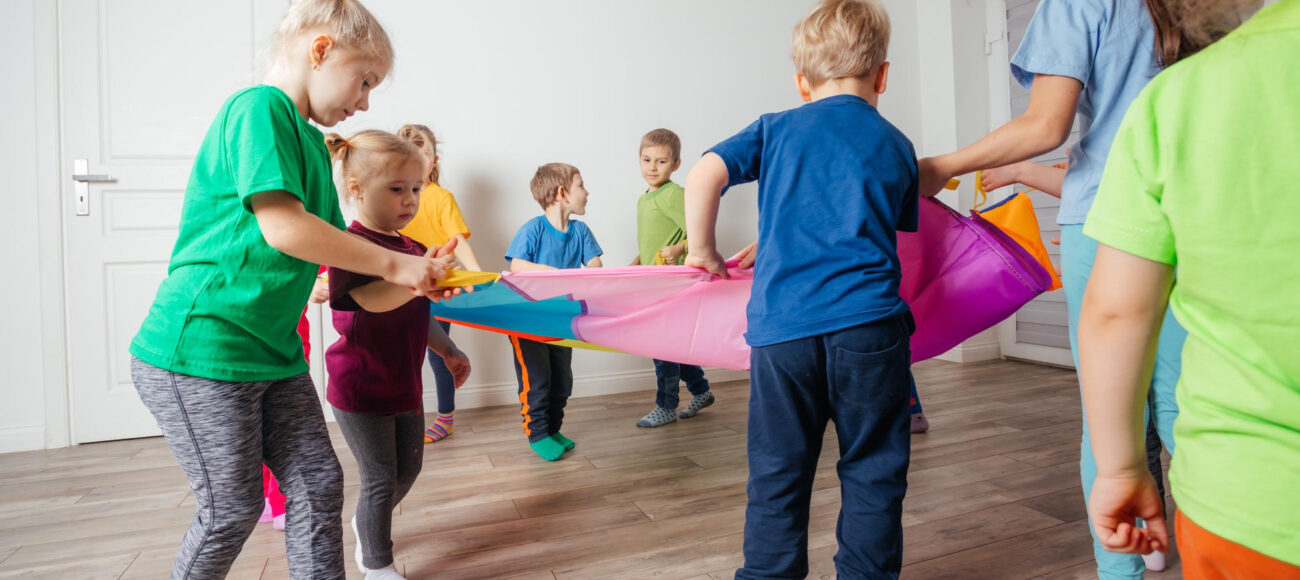
- Tug-of-war, ball-turning, obstacle course building.
Outdoor activities
Daily outdoor activities promote the natural development of large motor skills. It is worth encouraging your child to:
- Running on grass and puddles,
- climbing trees,
- Walking on rocks and balancing on tree trunks.
Self-reliance on the move
A child develops large motor skills best when he has the opportunity to explore the world on his own. It is worth allowing him to do so, for example:
- encourage independent dressing (putting on shoes, zipping up jackets),
- Involve in household chores - carrying baskets, sweeping, watering flowers,
- Give space for independent play and experimentation.
How does large motor skills differ from small motor skills?
Large motor and small motor are two different but interrelated areas of development. Large - involves movements of the whole body and large muscle groups (e.g. running, jumping, riding a bike). Small motorics - involves the precise movements of the hands and fingers, necessary for writing, drawing, cutting out or buttoning.
The child develops large motor skills first, and then small motor skills. If he or she has problems with body control or muscle strength and tension, he or she may have difficulty with fine manual activities.
Summary
Large motor skills are the foundation of a child's healthy development. It improves his physical fitness and influences his emotional, social and intellectual development. The Montessori approach places great emphasis on free movement, exploration of the environment and learning by doing. It is worth encouraging the development of large motor skills by giving the child space for movement, outdoor play and independent experience.
Providing children with natural physical activity is the best gift we can give them - development full of joy and freedom. When choosing an educational institution, pay attention to whether its staff ensures daily exercise and play outdoors, and whether the children in the hall have the opportunity to move freely (not running - we run outside, not in the hall for safety reasons!). Feel free to contact us - recruitment is open!
See also
- Small motor skills - what is covered by this term?
- How to support a child's interests using the Montessori approach?
- Beginnings, or how to approach kindergarten adaptation
- The Montessori method in a nutshell. How does the method work at ItsyBitsy?
- Preparing a child for elementary school after Montessori preschool education