

With the Montessori philosophy from the birth of the child
Maria Montessori, a pioneer of modern, scientific and empirical pedagogy from the ground up, created a concept of upbringing and education that accompanies the child from birth. Dr. Montessori emphasized that the first years of life are a crucial time for shaping the mind, emotions and body. Her guidance supports parents in ensuring the child's harmonious development, according to his natural needs and individual abilities.
Four phases of development according to Montessori
„It is wrongly thought that a child who has as many toys and aids as possible can develop best. On the contrary, an unordered multiplicity of objects newly burdens the soul with chaos and depresses it with a sense of discouragement,” Maria Montessori wrote long before our modern trend of minimalism and putting quality over quantity. What else important can Dr. Montessori convey to young parents?
What does it look like in practice to implement her philosophy from the first moments of a toddler's life? Let's start with the foundations of Montessori - the so-called child development plans.
Maria Montessori distinguished four plans, in other words, stages of child development. The first of these, covering the period from birth to age six, is the so-called „receptive mind” phase. During this time, the child absorbs his surroundings like a sponge, without the ability to select or evaluate the stimuli and impressions that reach him. That is why it is so important to surround it with love, beauty, tenderness and peace from the first moments. What a child experiences in the first days, months and years of life seeps into his deepest mental and emotional structures, shaping his future attitudes, reactions and perception of the world. This is the moment when everything should go right, laying a solid and lasting foundation for a fulfilled, happy life.
Within the „receptive mind” phase, Montessori distinguished two sub-phases: the unconscious mind plan (0-3 years) and the conscious mind plan (3-6 years). The first sub-phase is particularly important because the child not only gathers experiences, but also forms the basis of his skills and personality. What the child accumulates during this period, he will begin to use and organize, process, sort after the age of three. Although the lack of conscious memories of early childhood may suggest its lesser importance, research shows that this period shapes the foundations of future life. We know this, thanks to modern science. Maria Montessori also knew this, thanks to her unique ability to observe children over her many years of professional and scientific activity.
What did Maria Montessori know about young children and is it worth listening to her?
If, at this earliest stage of your child's development, when you are very concerned about providing the best for your child, not making key mistakes, not neglecting anything, you decide to listen to what the brilliant doctor and pedagogue Maria Montessori had to say, your life with your child will simplify, and you have the chance to achieve peace of mind and confidence in your new role. Dr. Maria Montessori is the kind of figure we can - through her writings - ask about an incredible number of things related to child development. And although she was active about 100 years ago, to this day - when we have incredibly more research at our disposal and have made key advances in psychology, anthropology or pedagogy - it's hard, really hard, to bend or catch her in the wrong reasoning!
What did Maria Montessori say about supporting infant development? She said, for example, that when a child learns to walk, he needs a ballet bar placed at the right height on the wall or something that will fulfill a similar role and help the child stand with support and take a few steps on his own. She pointed out that the child would benefit from something stable to push on. However, absolutely inadvisable is any kind of walker that will do the work for the child and will not contribute to the proper development of his bones and muscles. Ba she has even talked about soft shoes or walking barefoot! And this was long before the myth of the 'stiff heel’ in a shoe became a long-established and harmful norm. From the point of view of modern physiotheraputeic and developmental knowledge, Maria Montessori knew all the essentials.
Adjusting the environment for the newborn and infant
Dr. Montessori recommended that a child's environment should be safe, simple, without unnecessary decorations and promote free exploration. A prepared environment for the first months of a baby's life is not colorful stickers on the walls (we avoid those!) or teddy bear blinds, but above all:
- A comfortable, secluded place for feeding and cuddling: a large chair, necessarily a footrest, and next to it the first Montessorian basket, at this stage only for mom! Make sure that the basket does not lack a bidon with always fresh water, healthy snacks, a tetanic diaper, a blanket and a book.
- Sleeping space: an extra bed, a large mattress on the floor, a futon, a Moses basket (also useful during the day, not just at night) - the choice is up to the family.
- Changing area: a sturdy, comfortable changing table is not necessary, but it makes daily grooming very easy and helps keep the baby's surroundings tidy.
- Comfortable clothes made of natural materials that do not restrict the baby's movements.
- Baby sling to promote closeness, emotional and sensory development.
- Exploration of the environment: For a newborn and infant, everything is new, fascinating and needs to be discovered. His entire environment is the field of his first explorations. Items that can make this task easier and more enjoyable include:
- A comfortable, safe mat for lying on the back and stomach, preferably made of natural materials (such as sheepskin),
- A large wall mirror at the height of a lying child: this piece of equipment can prove crucial for the first two years of a child's life, as it greatly assists in building a mental map of his surroundings and, over time, will allow him to develop an awareness of his own reflection,
- Montessori visual mobiles: octahedrons, gobbi balls, dancers - these are classic Montessori mobiles recommended for the first stage of life. They are easy to find online, both in ready-to-buy versions and instructions for making them yourself.
Promoting sensory and motor development according to Montessori philosophy
Each stage of an infant's life brings different challenges and developmental needs.
0-3 months
Most important at this, but also at subsequent stages of the toddler's development, is the time and attention of caregivers. During feeding, bathing or changing, it is worth looking the child in the eyes, being gentle and attentive. During this period, the child also begins to be fascinated by his surroundings, so it is worth introducing:
- Mobile Montessori in contrasting colors, suspended above a reclining mat,
- Cards and booklets with clear patterns in contrasting colors (black, white, red),
- A soft mat or sheepskin for lying down.
3-6 months
The child becomes more active, begins to reach for objects and needs sensory stimulation:
- Wooden teethers and rag toys with tags.
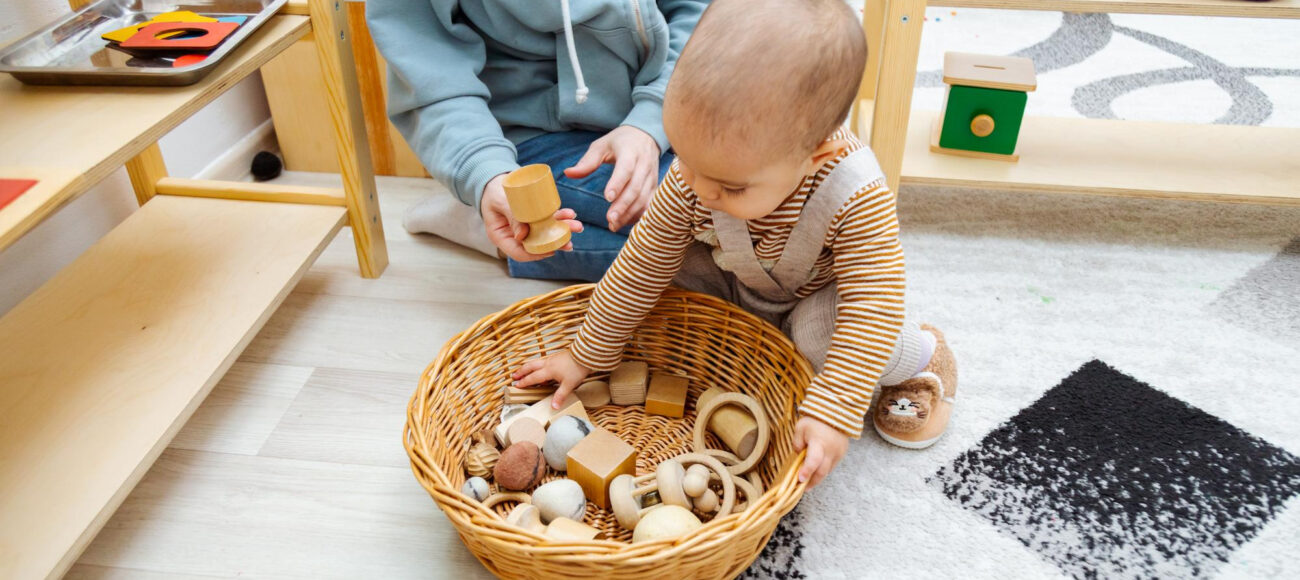
- First Montessorian treasure baskets with a variety of textures (e.g., three rubber sensory balls in a basket).
- Mirror on the wall, helping to develop spatial awareness, create a mental map of the environment, self-awareness.
- Wooden rattles and flexible wheels for manipulation.
6-9 months
The development of small and large motor skills is gaining momentum. During this period, it is worth introducing:
- Rotary drum (a classic Montessori aid for toddlers)
- Montessori puzzles with handles - the simplest, with basic shapes and grippers.
- Simple musical instruments (such as wooden rattles).
- Toys that support learning to grasp and manipulate.
9-12 months
Eye-hand coordination, small and large motor skills, and language develop intensively. To the aids accumulated earlier, which we do not get rid of, it is worth adding:
- Object Permanence Box (Object Permanence Box)
- Puzzle with simple shapes (circle, triangle, square) in primary colors
- Treasure baskets with animal figurines, household items, etc.
- Push and pull toys (not walkers!) and strollers for carrying objects (such as blocks).
- Ballet bar mounted on the wall at the height of the hands of the standing child. The space next to it can be lined with a safe rubber mat to cushion falls.
The role of the parent in the Montessori philosophy
A parent in the Montessori philosophy is an attentive observer and guide who supports the child in independent discovery of the world. It is crucial to build a relationship based on trust, closeness and respect for the child's natural pace of development. Dr. Montessori stressed that parents should facilitate the child's exploration by creating the right conditions, while not imposing their own expectations. It is important to accept and support the child's attempts at independence.
A sample day in the life of an infant in the Montessori spirit
- Morning: time for sensory activity - play on the mat with Montessori mobile and mirror image.
- Morning: walking in a sling, exploring the environment.
- Afternoon: relaxing bath, playing with a parent with simple musical instruments.
- Evening: looking at contrasting books, soft light, calm music and a hushed atmosphere before bedtime.
Montessori from birth - summary
Introducing the Montessori philosophy from birth is an investment in the harmonious development of the child and peace of mind for parents. Although Maria Montessori's concepts are more than a century old, their timeless value is confirmed by modern research. With simple guidelines, we can create an environment full of love, beauty and opportunities for the child to explore the world at his natural pace.
Montessori is not just an educational method, it's a lifestyle that builds a unique relationship between child and parent. And when a child reaches an age when he or she begins to be interested in other people besides parents, including peers, it's time to look around for a good Montessori facility in your area. Feel free to contact us now; early enrollment guarantees a place in the facility. See for yourself if you have the desire to make the formal education planned by the brilliant Dr. Maria Montessori the next step in your parenting adventure.